
How Institutions Kill Grassroots Organizing: CORE's Emergency NBI
Our union caucus fought to enshrine collective bargaining rights in Ohio's constitution. With more effective leadership, educators could lead the labor movement in Ohio.

CORE organizers won a Pyrrhic victory on Saturday; our New Business Item (NBI) passed, but it was amended into impotence by leadership. However, the work is just getting started—this Representative Assembly (RA) marked CORE’s first move to reform a state affiliate, and the explosive entrance opened a new path for rank and file union siblings.
Missing context? Start here:
CORE Submits Emergency New Business Item for State Affiliate Meeting Dec. 6

On Sunday, November 30th CORE organizers submitted a New Business Item (NBI) for the Ohio Education Association (OEA) delegates to discuss and vote on at the upcoming Representative Assembly (RA) on Saturday, December 6, 2025.
When CORE organizers in OEA submitted their NBI, they anticipated a bloated price tag, but none of us expected the outright absurdity of the final number: $52.4 million, almost ten times more expensive than the 2023 signature drive to enshrine abortion rights in Ohio.
Organizers knew that if they had any chance of getting the assembly to back the collective bargaining initiative, the price tag would have to come down. A lot.
In accordance with the NBI proposal process, the maker of the motion received a phone call the Wednesday before RA to discuss any challenges or questions. As expected, the challenge with the NBI was cost and the lack of existing labor partnerships with the state affiliate. Still, there was a mutual desire to hear member voices on the floor.
To ensure those voices were well-informed, CORE organizers brought flyers on the morning of the RA to hand out just before delegates entered the designated floor. We got shut down. A woman from the planning committee came up and asked who had given us permission to flyer. An organizer responded, “No one, because my understanding was you only needed the President’s permission for materials distributed on the floor.” She went to ask the OEA President, came back, and delivered the verdict: he said no.
Later, we looked in the RA manual. We were right; “on the floor” was the exact language. A pair of organizers approached the woman again, and she disputed our interpretation; leadership considered the entire building hosting the event as “the floor.”
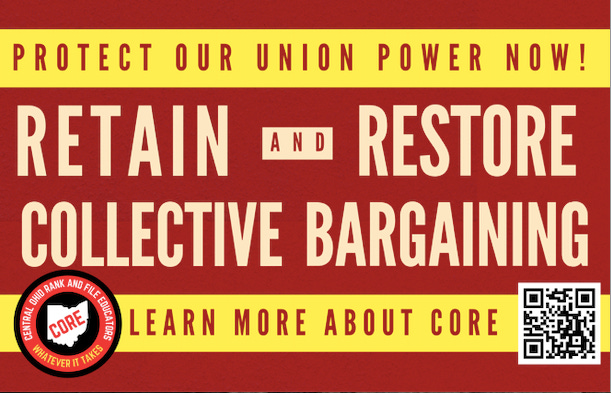
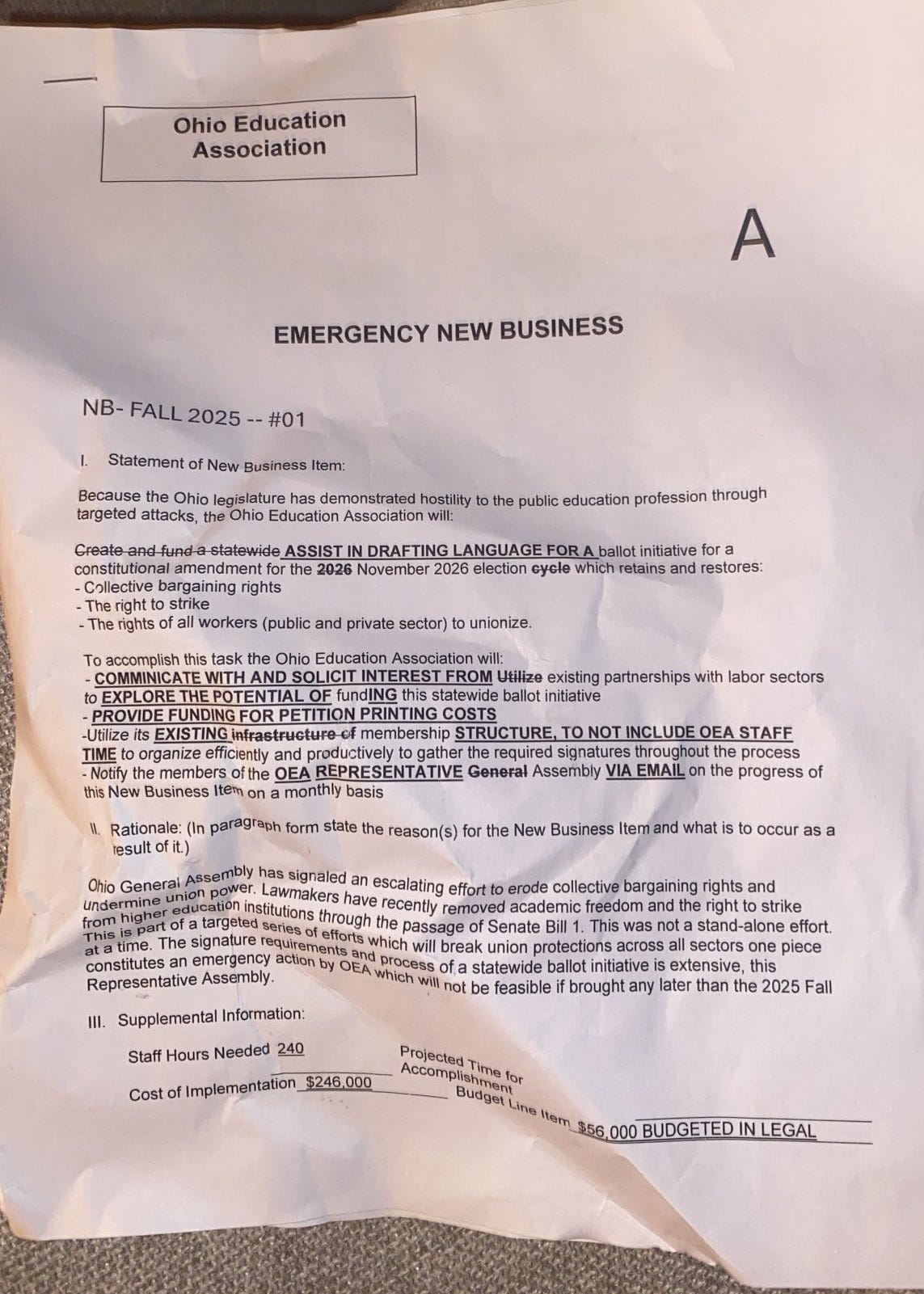
Once the RA began, CORE organizers worked diligently with the OEA legal team and financial director to amend the language to capture exactly what the caucus wanted. Though this process was lengthy, it was true union work and showed the incredible resources members can actually access. They helped us to craft the NBI language down to the exact word, asking clarifying questions along the way and providing helpful insight.
The group was able to get the NBI cost down to $246,000—a nominal fee for a union as big as OEA—reflecting the true ask: utilize the institution’s lawyers to assist in drafting a statewide ballot initiative supporting a constitutional amendment to retain and restore collective bargaining rights, the right to strike, and the right for all workers to form and join a union.
The amendment also included OEA communicating with labor partners and soliciting interest in the effort. The opposing amendment, which ultimately succeeded in killing our motion, focused exclusively on this part. Our amendment would have allowed the institution to do both: invest in members and garner interest. However, that detail was lost on members because of tactics from leadership, and only the latter would survive.
Regardless, this was to be done by the 2026 November election, the most favorable upcoming election we have: people will be turning out for midterms, and we have the gubernatorial election. Leadership disagreed, claiming during debate that this work could hurt the union’s efforts to elect Amy Acton.
Despite decades of union-busting capitalists suppressing the working class, CORE believes Ohioans are pro-union. We saw this constitutional amendment as only helping Amy Acton and communicated that to membership. Amy Acton is pro-public education and pro-union; our amendment would only add to her platform and sway voters.
In the end, leadership would succeed in obfuscating these nuances through procedural smoke and mirrors. We expected those and other kill tactics within the norms of parliamentary law, but what we experienced was an extreme deviation.
The Chair spoke openly against the NBI, and all points of information were forwarded through the Chair to an OEA staffer (who was also openly hostile to CORE organizers) instead of allowing the maker of the motion to respond. Through this weaponization of the request for information, no rationale or sense of urgency for the NBI was communicated to the membership. CORE members had to reprimand the Chair for taking a stance twice; if he wanted to speak for or against the motion, he needed to relinquish the Chair to a neutral party.
CORE members fiercely defended the original language of the NBI. The maker of the motion pointed out that as much as she wished this move were proactive, we were already on defense. Senate Bill 1 is now Ohio law, banning faculty in higher education from going on strike.
Another speaker, quoting the OEA President from earlier in the day, asked, “If not now, when?” while urging the assembly to consider the power we have in every school in every county in the state.
The amendment that killed the motion was put forward by an OEA Director, who was awarded the opportunity by the Chair to speak twice while others waited. When the amendment was first ruled out of order (it sought to amend language that had already been struck by the maker of the motion through our own amendment), the Chair tepidly conceded, “I am going to ask [Director] to withdraw his motion.” The Chair also spoke openly about “the plan” when speaking of amending CORE’s NBI. This shows the Chair of the meeting was helping to implement strategy against a member-driven and proposed new business item.
Throughout the debate, the Chair and several OEA Directors revealed a contemptuous stance toward the union’s democratic structures. This contempt was aided by the failure of both Parliamentarians to ensure the Chair followed parliamentary procedure.
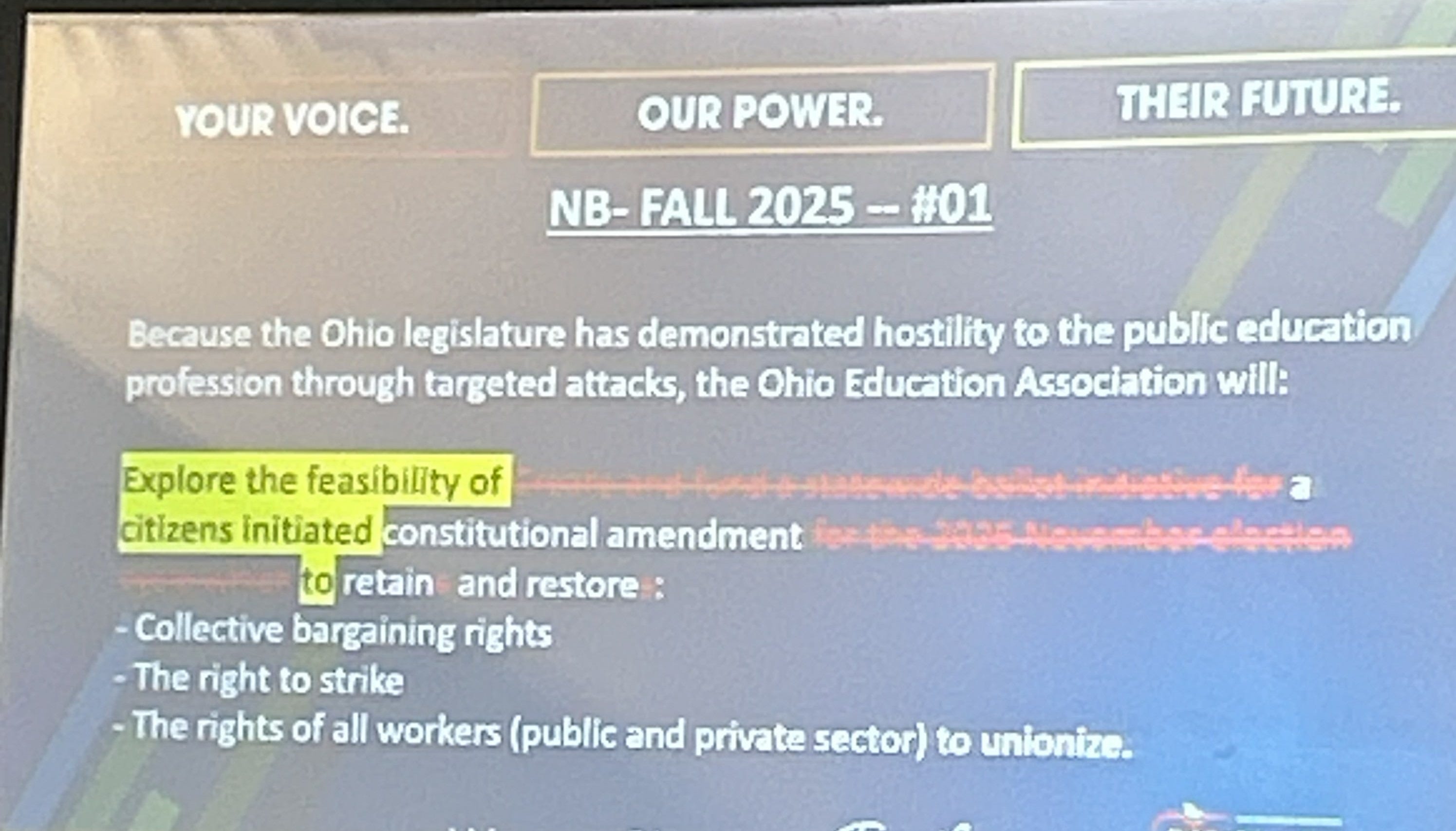
Ultimately the motion was amended and passed as an effort in which OEA will gauge interest in and explore the feasibility of protecting collective bargaining rights and bring forward something to the OEA general assembly at the spring 2028 RA. Leadership left the process and timeline for doing so intentionally vague.
OEA will now spend $250k to collect data and decide if the effort is “worth it” with no clear deadline—in other words, to do nothing—by 2028 instead of spending $250k to give rank and file members a shot at protecting our collective bargaining rights.
Still, the fight is far from over. The membership absolutely resonated with CORE members’ message, as our caucus has continued to grow since the RA. CORE will continue organizing, and at the Spring RA, we’ll be back to fight like hell for every educator, student, and worker in Ohio. We’re the ones we’ve been waiting for.