
NEA Tomorrow: Five Lessons from the Representative Assembly
Today, NEA does not represent the union our educators deserve. It’s time for the rank-and-file to push for a better tomorrow.

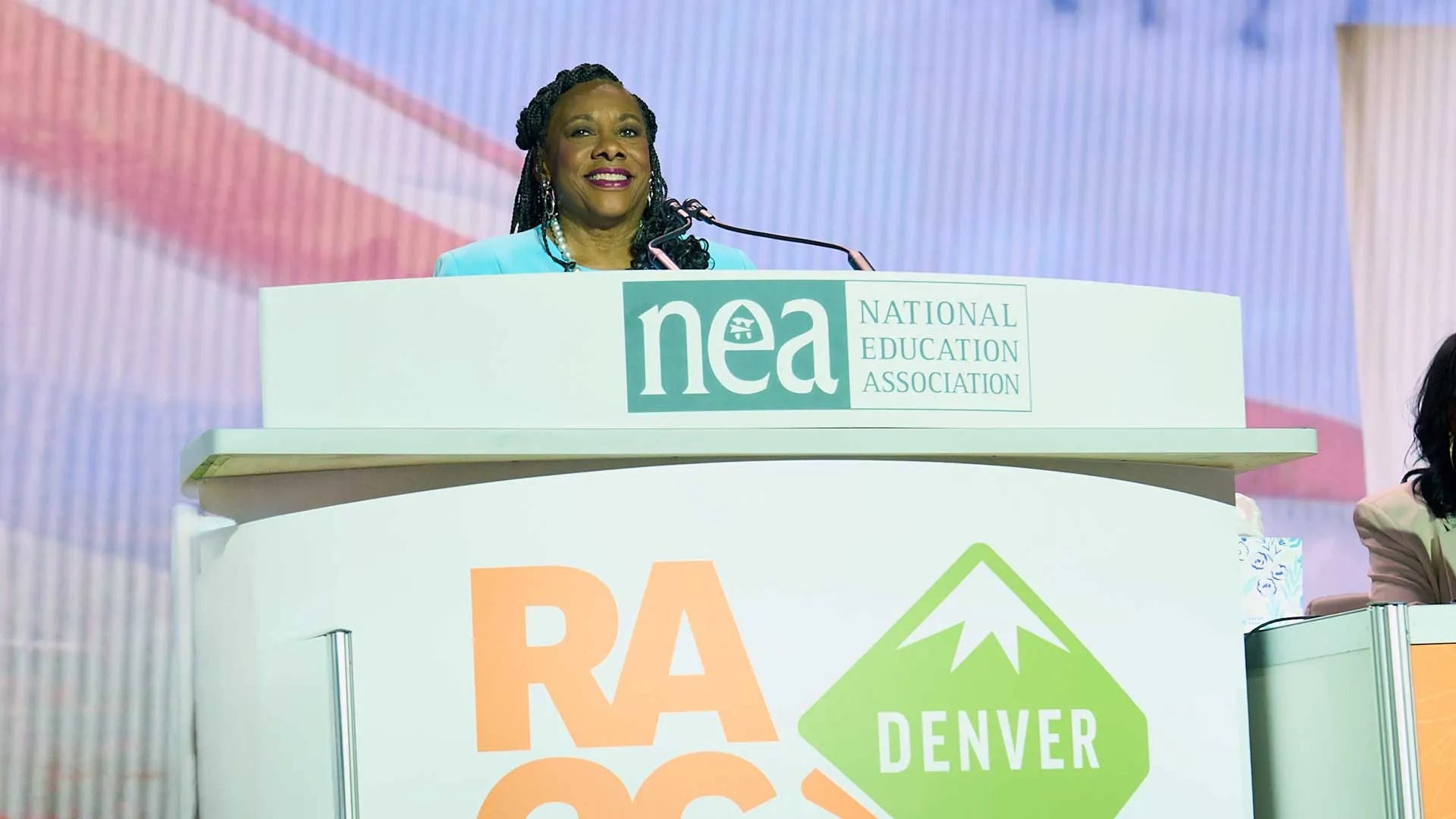
An election of president, vice president, and treasurer; condemnations of genocide, antisemitism, and ICE kidnappings; steak dinners, open bars, suits and skirts; democracy, power, and budgets; no shortage of themes circulated the four days of the largest democratic assembly in America. This July, 5,934 educators congregated in Denver for the Representative Assembly (RA) of the National Education Association (NEA). The annual gathering’s 105th edition would seem poised for action to respond to unprecedented attacks on public education and democracy itself.
To echo retiring NEA President Becky Pringle, “Delegates, I really need you to listen closely right now”: America’s largest labor union won’t save us, and it will be lucky to save itself when push comes to shove.
Against the backdrop of deteriorating conditions across education, the Representative Assembly managed to pass only a single New Business Item (NBI) that went beyond symbolic action or gathering and disseminating information. With a contingency fund totaling a measly $1.9 million, actions reckoning with our moment in history were slapped with exorbitant price-tags and pushed to the last day of debate, guaranteeing the delegation’s willingness to vote in line with leadership’s conservative stance in the name of fiscal responsibility.
Our caucus, CORE, works on the local and state levels to build democratic rank-and-file power in Ohio; however, our critiques of top-down decision-making on local levels requires analysis of the larger power structure subsisting our affiliates. Especially in the Ohio Education Association (OEA), our leaders show great fidelity to national leadership and suppress criticism thereof. Indeed, at this very assembly, members of our caucus faced retaliation for actions taken in disagreement with national leadership. If we want our unions to build power through the rank-and-file, we must understand how the larger system motivates those who currently wield power within that structure.
Many delegates accept or simply miss the subtle ways leadership siphons power away from the RA, ostensibly the highest decision-making body in the union. With that body’s limited time being drained away by faulty voting machines and debates about whether or not to publish various articles for NEA Today, matters of greater urgency—and greater risk for those with power—get pushed to the sideline. That’s to say nothing of the endless discordant speeches celebrating various leaders as though we were winning the battle for public education, nor of the “Days of Learning” professional development sessions: four hours of Union 101 lessons (with some notable exceptions) for seasoned representatives who already won elections to attend this assembly. The wastes of our time were insulting.
If we really believe public education and the democracy it establishes face existential threats today, we need more from the National Education Association.
Our caucus believes the remedy starts with an unvarnished reflection on the four-day fever dream of the RA. To that end, we present to you NEA Tomorrow: a mini-series of five articles touching on the most important lessons we learned while engaging with this year’s assembly. Over the next few weeks, we will expand on each of the following lessons we learned while envisioning a better tomorrow for America’s unionized educators.
1. Everything is made up and the points don’t matter.
Delegates submit NBIs to the RA to appropriate funds towards various projects aligned with the union’s broader mission. They bounce between NEA staffers and the makers of the motion several times to adjust language, scope, and, most importantly, cost. Adding a phrase like “using existing channels” can be the difference between hundreds of thousands in the final cost, and when that represents 10% or more of the available budget, delegates have a lot of incentive to drive down the price to pass their NBI. Writ large, the items brought to the floor tend towards dissemination of information, symbolic actions, and absolutely nothing of significance in the national political picture.
There is, however, a way for the RA to open the books and reconsider all of NEA’s spending, which totaled $448,171,192 in 2025—a far cry from the $1.9 million contingency fund (money left over from the established budget). Stay tuned to find out how and why it may be our best option to reform our national union.
2. NBI pricing supports and represses specific ideologies.
Even if we want to believe that publishing in NEA Today can meaningfully impact various issues, how do three similar proposals for the publication end up with such disparate price tags of $7,000, $35,000, and $222,000 each? Without an obvious answer, we attempted to consult the World of Information, an online portal for NEA delegates to find answers to basic questions about various motions. In theory, the World of Information empowers delegates to ask all kinds of convoluted and technical questions without clogging up debate with Points of Information, and it gives makers and NEA staffers time to answer questions thoughtfully and thoroughly.
In practice, however, the “World of Information” is a bit of a misnomer. We asked for the cost estimate breakdowns of three NBIs in order to understand how they were priced so differently for similar initiatives and received the following response:
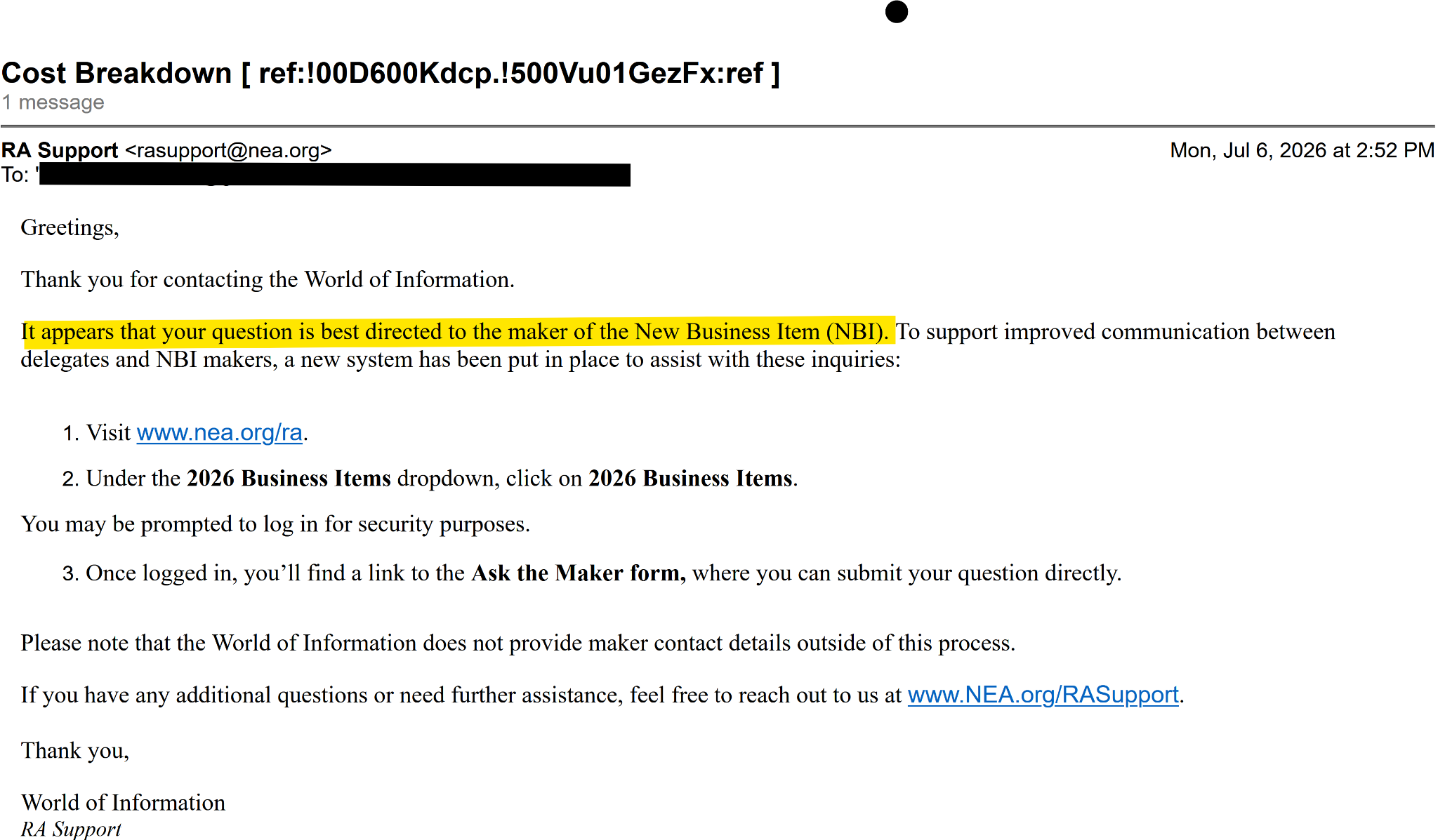
After consulting the makers of these motions directly, it became clear that they were just as confused as we were about these disparities. One had not received line-item breakdowns of the cost estimate at all, whereas the $222,000 motion had only two lines included: approximately $22,000 for writing the piece and $200,000 in estimated legal expenses. Digging deeper, the broader trend becomes apparent: the more an NBI aligns with NEA leadership’s agenda, the more favorable the price tag, and vice versa. Follow the Member Action Tea to learn more.
3. “The medium is the message.”
The RA serves as the ultimate medium for debate, messaging, and decision-making in NEA, and it utilizes New Media—electronic media created for mass consumption—to disseminate various ideologies to delegates. Between the giant video screens, daily email updates, and electronic voting machines, the structures of those media shape beliefs and behaviors even more than the content therein, calling to mind New Media theorist Marshall McLuhan’s famous proclamation, “the medium is the message.” What are the unstated, unconscious messages delegates absorb through the media pervading the RA? In this piece, we will utilize New Media Theory to explore how the very structure of the RA reinforces compliance and fidelity to leadership, a hand-picked line of succession, and ultimately, a stultifying neoliberal ideology.
4. The PAC is the point of the RA, and it doesn’t serve members.
At the NEA RA, the Political Action Committee (PAC) dominates every call to action—donate to the PAC, and your elected leaders will use the funds to support pro-public education candidates across the nation. The PAC ostensibly gives educators a means of consolidating resources to fight back against corporate interests in a post-Citizens United world.
If Ohio’s PAC is any indication of the national PAC, however, the more likely reality is that it only serves as yet another means of upholding America’s two-party hegemony. In this piece, we interview Jessica Harper, an OEA member running for the Ohio House of Representatives who could not get OEA’s endorsement or PAC funding. Her opponent, incumbent Jason Stephens, automatically received OEA’s endorsement and a $16,615 PAC donation as a “friendly incumbent,” despite voting for HB 96 with his Republican colleagues to defund Ohio’s public schools by $2.75 billion. The RA gave our caucus a chance to learn from Harper about how the PAC works against educators in Ohio, providing greater reason for skepticism of the national PAC as well. But be forewarned…
5. If you defy the PAC, you will face retaliation.
Ohio’s caucus met for two hours each morning of the RA for updates, debates, endorsements, and of course, to play games pressuring delegates to donate to the PAC. Two members of our caucus refused due to our experience with local and state PAC behaviors. They faced some of the usual boss behaviors in response: isolated conversations, shaming, and advice from leadership to expense the donation on the travel voucher, which is explicitly forbidden.
On the last day of the RA, however, OEA leadership announced 100% participation in the PAC, to the absolute shock of those two delegates. The ensuing chaos of the day revealed that their rights had been violated: OEA leadership had violated federal law by accepting an anonymous cash donation in their names, known as a straw donation. The whole saga reveals the pressure local and state leaders experience to get their delegates to donate, the lengths they will go to reach 100% participation, and therefore the leverage and power delegates could hold by coordinating their refusal to donate to the PAC.
In our last edition of NEA Tomorrow, we’ll spill all of the still-brewing tea. If you’re a unionized educator, consider subscribing to our Substack or joining CORE to help us fight for a more transparent, democratic, and member-driven union.