
State Affiliate Union Holds Town Hall with Legislators, Questions Remain Unanswered
The Ohio Education Association gathered educators and legislators on the topic of public education, to ...? (we don't know)

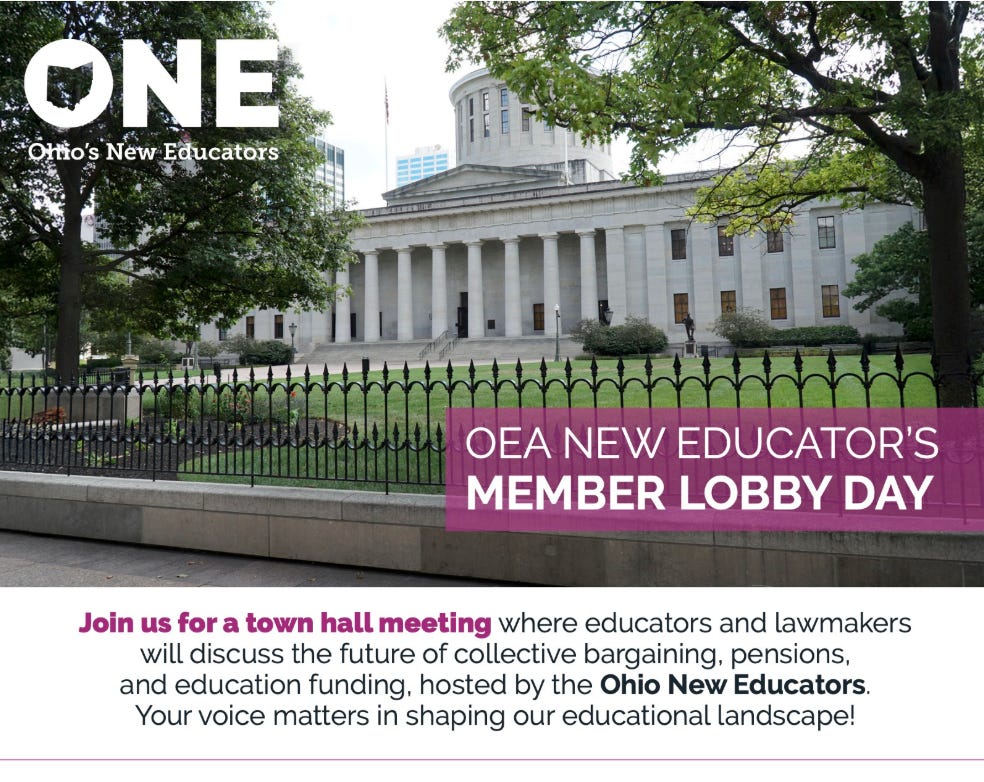
On Tuesday, October 21st, Ohio New Educators (a group of OEA members from across the state, in years 0-10 of the profession) held a town hall meeting with four legislators: Louis W. Blessing, III (R - District 8), Jason Stephens (R - District 93), Nickie Antonio (D - District 23) and Dani Isaacsohn (D - District 24). The event was advertised (as pictured above) to discuss collective bargaining, pensions, and funding.
Four questions were posed to legislators over the course of one hour. The event was moderated by a staff member of OEA, and panelists were not held to a time limited response, nor were answers given in any sort of order. It was all a bit loosey goosey around topics that are anything but.
Question 1 asked the panelists, “What does a successful graduate look like to you?”, in which Blessing (R) gave a refreshing answer that highlighted the importance of general education for all amidst programs and companies pushing for career tech starting as low as middle school.
Teen isolation, mental health struggles, and the failure to teach younger generations on how to navigate the digital world were all voiced by Isaacsohn (D), with an emphasis on the role of public education being to bring students together and have real life experiences that they (and we) learn and grow from.
Stephens (R) brought up the need to have schools provide the practical resources they used to, such as driver’s education. Access to driving is a serious barrier for the majority of rural Ohioans, and is felt within the city districts too, due to Ohio’s lack of public transportation.
Antonio (D) said kids should know their options, have experiential learning, and while she pushed back on the recent child labor expansion, she said all graduates should have a mandatory one year of service after high school graduation.
Question 2 dealt with school funding and asked legislators how to balance it with property taxes. While Blessing said the Fair School Funding Program is property tax relief in itself, he also voiced a need for a Constitutional Amendment that would allow local school boards to raise property taxes/pass levies without the issue going to the ballot box. He stated that the “aspect of democracy” remains in the fact that school board members are elected, so constituents can use the avenue of electing school board members if they are unhappy with not having a say in the amount of taxes they pay.
CORE would like to take a moment and remind readers that in June, the Ohio legislature reduced the mostly-elected-19-member State Board of Education to 5 appointed members. The Ohio legislature does not value elected school boards, what makes us think they will protect that democracy at the local level?
Stephens called for simplicity to local funding, and made the call to get rid of term limits so there is “more expertise” on “how we govern”. (Yes, you read that correctly. And no, the moderator did not ask any clarifying questions nor was it challenged by anyone on the panel.)
Antonio said the state needed to pay more and, regarding the further gerrymandering of Ohio’s legislative maps, “we’re going to have to figure it out. If not now, then down the road.” Isaacsohn called for a Constitutional Amendment for the state to pay for 50% of public school funding.
Question 3 was, “What recommendations do you have to improve teacher retention and recruitment?” Blessing acknowledged that while some love the “but they get summers off” talking point to explain abysmal salaries, it’s clearly countered by the severe teacher shortage, and called to “sweeten the pot” for teachers.
Stephens said we need to make it easier for people to be teachers, and there are several barriers to entry, such as getting an education. While it sounded like what he could have meant was the wildly climbing costs to licensing, that’s not what he said. Antonio looked into the audience and said, “We need you, we need teachers to run for office”. (Note to self: find time to run for office between differentiation, PBIS, public school works, dyslexia testing, RIMPS, and buying classroom supplies.) Isaacsohn swooped in with a voice of a reason and said they were making it too hard: pay teachers more, give them better benefits, and improve their working conditions.
The moderator posed a follow-up question only to Antonio, who had earlier highlighted that she was a special education teacher: What can we do for special education recruitment and retention? Antonio voiced that we are all better people because of special education, and bringing people of different abilities together is important for society. While this is unequivocally true, Antonio gave no actions steps to this answer. Antonio taught special education in the 1980s, with her last teaching license expiring in 1992.
Question 4 was not one from the list of submitted questions by union members for the town hall, but rather a question the moderator said he wanted to ask. The last question posed was, “Can you tell us about an educator that impacted you?”. While it could have been an acceptable icebreaker or introduction question, it instead mimicked a tactic that’s helped keep an entire profession exploited: Remember your why.
The turnout for the town hall was quite small, with no more than 30 people total, several of whom were union staff and not educators. Most educators present were already in Columbus for OEA’s lobby day; very few were able to make it to the union’s headquarters in downtown Columbus by 5pm on a workday.
The reception that followed brought more union staff and even fewer educators. With the panel not even addressing the concerns of collective bargaining or our pensions (which was how it was advertised), the moderator not sticking to questions posed by educators, and the vast inaccessibility of the town hall, it leaves one wondering: Who was this event for?