The Member Action Tea: November 2025
Election recap, Columbus CORE caucus stands up to their leadership, and we're serving tea on behalf of stoners, library workers, and baristas.


November 4th’s election night brought public education wins to city, suburb, and rural districts across the state, though notably avoiding Columbus. Below is a quick recap.
Levies and Bonds
Olentangy Local Schools Bond - Yes 56%
Will fund the construction of a new high school and an elementary school, along with other infrastructure and safety updates.
Jonathan Alder Local School District Bond - No 50.13%
This would have funded construction of a new middle school and to renovate, repair, expand, improve and construct additions to current facilities. There may be hope for JA yet, as the result was close enough to likely trigger a recount, and the Board of Education is considering legal action against the Union County Treasurer Office.
King Local School District 1% Income Tax - Yes
Westerville City Schools, Earned Income Tax Levy - Yes, 60%
Local unions and school boards alike should be taking note of the victory for Westerville City Schools, who also voted in union-endorsed Board of Education members, resulting in a 100% union-backed school board, in edition to a funded district, despite the continued divestment from the state. The passage of this earned income tax levy, which WEA members mobilized in droves to support, avoids $20 million in cuts.
Walnut Township Local School District Emergency Levy No - 53%
Southwest Licking Local School District Bond No - 70%
Delaware City Schools Tax Levy Yes - 52%
Delaware City Education Association activated over 10 percent of their membership to canvass and partake in a text campaign in support of the levy.
Jefferson Local School District Income Tax Levy Yes - 69%
School Board races
Southwestern City Schools
The Democrat slate of Kelly Dillon, Chelsea Alkire, and Camile Peterson won. The slate, endorsed by South Western EA, faced an attack when the opposing Republican slate created a deepfake AI generated video of the endorsed candidates expressing false opinions.
While this has been a voiced fear from the tech industry and content creators alike, this was the first time (to CORE’s knowledge) we saw it interfere in a very real way. While social media can be a friend to campaigns, it reminds us that in-person, real-life member and community engagement will bring us the wins we need!
Pickerington
A notable candidate on the Pickerington ballot was Brooke Lagrosso, CCS educator, CORE-Columbus EA member, and special needs parent. Running on a platform of classroom teacher representation, community engagement, and board involvement, she gained both Pickerington EA and Columbus EA endorsements.
Through CORE organizing she was able to fund a crucial part of her campaign, as a CORE-CEA organizer who sits on the union’s PAC put forward a motion for monetary support to Lagrosso’s campaign. Educators supporting educators - we love to see it.
Upper Arlington
Board of Education President Lou Sauter was unseated by a former-admin-now-Board-member, and though we always have speculation when a former boss becomes a bigger boss, newly elected Francis (Kip) Greenhill seems to be teacher-friendly and very much in support of progressive education. In other great news, Board member Nidhi Satiani, known and appreciated for her activism and transparency, retained her seat.
Columbus
The Columbus EA slate and the Franklin County Democratic Party slate differed by one candidate, and it was an important one. Organizers made videos and slide decks for union leadership to educate fellow members on the importance of the race, though those materials went unused, and member mobilization totaled 13 out of 4,300. The community saw another election bought and paid for by the Franklin County Democratic Party.
While two of the three seats were won, the union did not flip its hostile board of education, despite a contract re-opener on the table and going on 4 years post-strike.
Canal Winchester
With no current PAC and no endorsements, CWEA chose a path of transparency that brought educators and community together: they hosted a candidate night for their school board race.
Candidates were asked pre-determined questions without the ability to prepare an answer. Questions rotated, providing every candidate a chance to answer first, and responses were held to a one minute time limit.
Attendees (educators, parents, and community members alike) said hearing the candid replies helped them make an informed decision, and perhaps most impressive of all, was the high school student that stepped into a leadership role and facilitated the event.
Looking for us to cover your district? Let us know by sending an email to info@core4ed.org.
Why Didn’t Columbus Educators Endorse Emmanuel Remy? Ask CORE.
One of CORE’s founding principles is fair and full funding for our public schools. Ohio’s lawmakers have abandoned the Fair School Funding Plan in order to funnel public dollars into private pockets via never-ending voucher and charter expansions which destroys public education.
We must fight privatization at every opportunity, including local elections. If a politician takes vouchers, they should not get our endorsement. This logic would seem relatively uncontroversial, but unfortunately, the Columbus Education Association’s leadership disagrees.
Emmanuel Remy is the Columbus City Councilman for District 4. This fall he was up for reelection and ran unopposed. His spouse is a CEA member, his children have been in CCS schools, and he has said nice things about public education, so this kind of endorsement would normally get rubber stamped without a second thought.
Political endorsements are a process that starts with CEA’s Political Action Committee (PAC): Teachers for Better Schools (TBS). TBS screens candidates and issues and makes a formal recommendation to the union’s Board of Governors, who are elected union officials that represent hundreds of members and faculty representatives. If the Board of Governors approve the recommendations, it then goes to the union’s Legislative Assembly (the body of all elected faculty representatives), who have the final vote on the matter.
A CORE-CEA member currently serves on the board of TBS. The TBS Board had, for the first time, chosen to not endorse Zach Klein, Columbus City Attorney, based on his use of vouchers for his children’s education.
The TBS Board had voted to endorse Emmanuel Remy; however, shortly after the screening of candidates, she received (and verified) the word that Remy takes vouchers for his kids to attend a private Catholic school. She notified a CEA Governor and CEA’s president, and attended the next CEA Board of Governors meeting to urge the Governors to reconsider Remy’s endorsement.
The ensuing discussion, while dynamic and passionate, ultimately landed on the idea that Remy “shouldn’t be punished for following the law,” conflating legality with morality. It’s perfectly legal for a union member to cross a picket line, but to say they shouldn’t be treated differently for it would be asinine.
Regardless, the CEA Board of Governors voted to approve Remy’s endorsement (with some noted dissent), and it moved to the Legislative Assembly. CORE members would have to step up, defy leadership, and toss the dice of democracy.
Democracy only functions in concert with functional media; an uninformed public cannot vote for their values. To ensure members are informed on the issues for which union caucuses stand, they create alternative streams of information through which otherwise sunken stories can resurface and be rescued.
Similarly, if the Board of Governors had managed to defeat our plucky underdog’s spirit, CEA union reps wouldn’t know they were endorsing a voucher recipient for city council.
CORE members tend to be nothing if not persistent, however, so she sent an email to CORE-CEA members (i.e. CEA members who had signed up for the caucus) in an effort to inform them of the situation and that the endorsement was in direct conflict with CORE’s central demands.
The email encouraged the caucus to embrace the democratic structures of a union by contacting their elected union representation—the governors—or partaking in discussion at the upcoming Legislative Assembly.
Leadership found out and didn’t take kindly to that.
Some Governors took offense to the email as though being elected to union leadership insulates an official from disagreement. Others fundamentally misunderstood how caucuses work and accused CORE of some unspecified impropriety. They also took the move as an unethical use of member information, overlooking the fact that the email only went to CORE-CEA members.
On the day of the Legislative Assembly, the endorsement issue started right off the bat in public comment, as CEA leadership invited Remy’s spouse, a fellow CEA member, to speak and urge the faculty representatives to endorse her husband.
The CEA member owned her family’s use of vouchers, specifying the exact Catholic school they chose, their children’s educational path, and, in all due fairness, the fact that one of their three children still attends CCS.
As qualified and careful as the message was, it established a palpable tension. As the speech came to a close, whispers rippled around the room—“There are some good high schools in that area...what’s wrong with them?...Everything we do is political; we’re educators.”
CORE does not say any of this to tarnish our fellow member’s reputation. If these political critiques feel personal, perhaps the point has been demonstrated: “personal” and “political” are a false dichotomy.
The meeting finally reached New Business and the formal recommendation of the Board of Governors to endorse some great candidates—Jesse Vogel chief among them—, some unsurprising institutional choices, and one now-controversial name.
Immediately after reading the New Business Item, the president relinquished the chair, signaling his intent to speak on the New Business Item. Now addressing the floor as a fellow member, he spoke to “realpolitik,” the pragmatic benefit of endorsing someone like Remy, with whom he will have to meet either way. There were some generalities about Remy’s contributions to our schools, but apparently nothing memorable enough to specify.
His speech would be the last in support of Remy that evening.
As he spoke, a CORE member who was motivated to act by the caucus email started a line at the mic to make a motion. She moved to amend the main motion by removing Remy’s endorsement, emphasizing the damage being done to public schools while our taxes subsidize wealthy elites. Our schools crumble, our district faces a $50 million deficit, and meanwhile, lawmakers bend over backwards to fund private schools.
Another CORE-CEA member sprang up to second her motion, acknowledging the hard work of our union officers—nothing personal, after all—before pivoting to draw a hard line: the purpose of vouchers is to destroy public education, full stop. If we never stand up for our principles and defend public education, nothing will change.
A third CORE-CEA member brought it home by holding up his voting credential card to remind members that they may vote for whatever they think is right. What gives us the right to judge Remy’s use of vouchers? That card. Leadership has made their recommendations, and now the legislative body can decide whether his choice, while legal, crosses an ethical line for our union.
None of the Governors spoke against the motion to strike Remy from the endorsements.
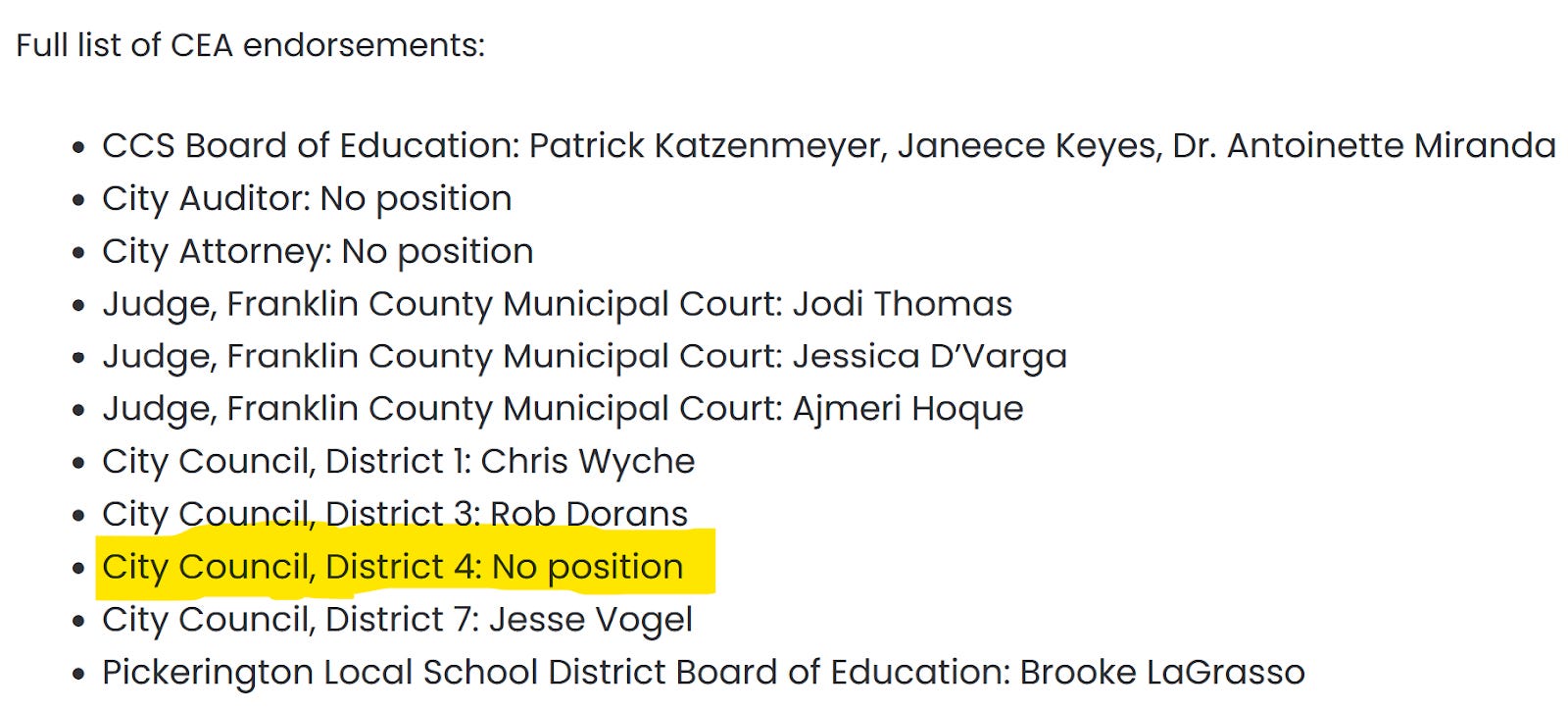
The chair called for a standing vote, and the Legislative Assembly made its stance known: approximately 75% rose in support. The rest voted against, and it was done. Without much fanfare, the main motion continued as amended, passed unanimously, and found publication that evening:
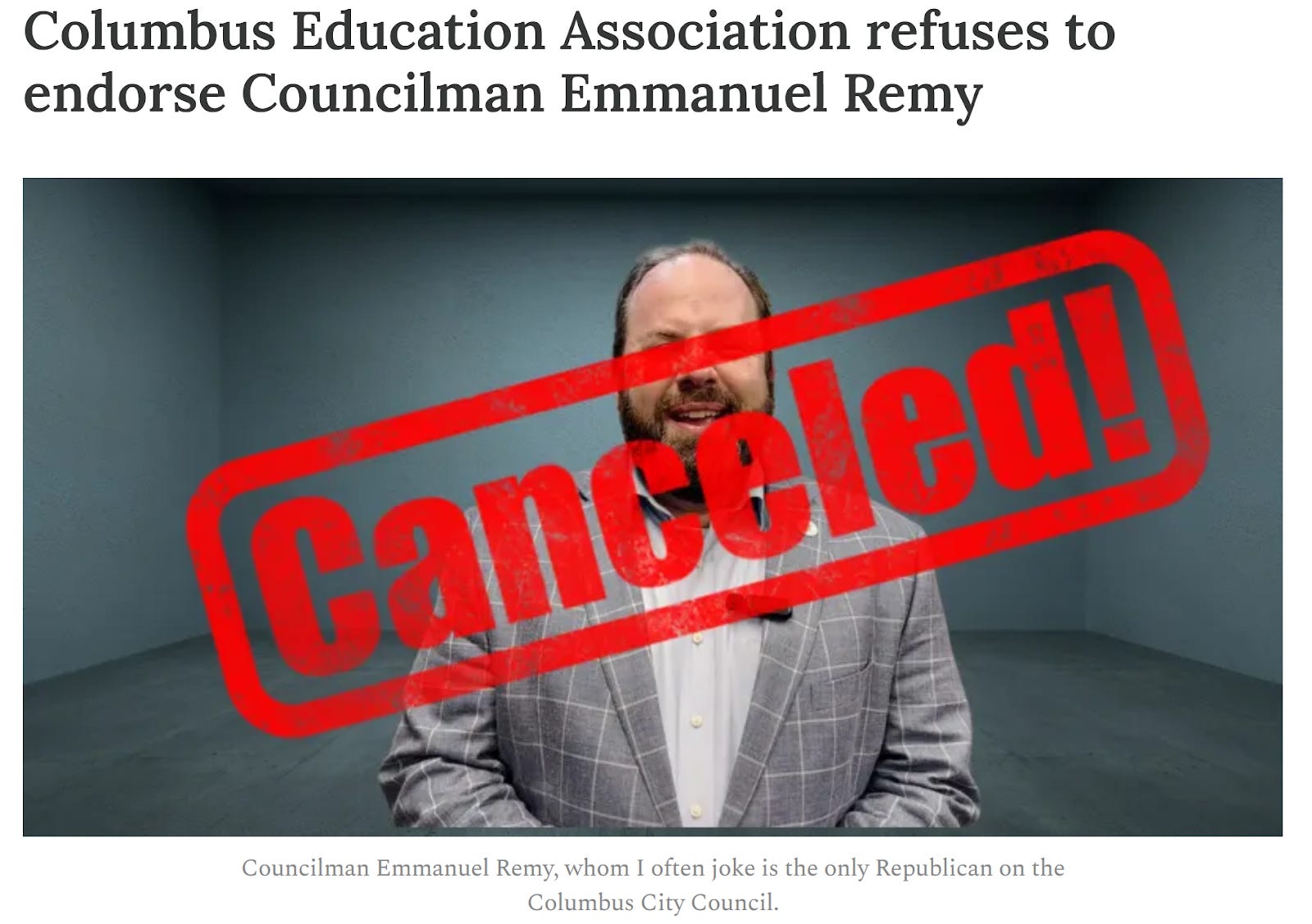
And by the next morning, a local independent journalist already picked up the thread:
That’s the power of rank and file members organizing through a caucus. Instead of taking the path of least resistance, CORE-CEA helped members to be informed, unify behind their shared values, and to act upon them through democratic structures.
Library Workers, Stoners, and Baristas

Columbus Metropolitan Library Workers Are Unionizing!
Columbus has one of (if not *the*) best library system in the country, and it’s about damn time their workers are compensated for it. It’s no secret the Ohio Federation of Teachers (OFT) has been helping public libraries organize like crazy the past few years, from Worthington, Upper Arlington, Grandview, and now Columbus.
Two of CORE’s central demands are fair and full funding and academic freedom, and we proudly include public libraries and their workers in these points. Show your support for CML workers by signing their pledge and keep an eye out for their campaign material. If it’s anything remotely close to the CML tiktok content (@columbuslibrary), it will definitely be worth the read/watch.
Stoners on Strike
The employees at Herbal Wellness Center on East Main street in Columbus have been on strike since September 27th. The union has been in contract negotiations with their bosses for over a year, and with the company refusing to bargain in good faith, the members have been holding their picket line strong for weeks due to the unfair labor practices. Follow their instagram @hwcunited for updates and opportunities to support their picket lines, and until they get that contract, buy your marijuana somewhere else!
Starbucks Workers Hold That Line
Starbucks Workers United (SBWU) is going on two weeks for their nationwide ULP strike. Not only has the union been very strong in central Ohio, but they shut down one of the largest Starbucks distribution centers with their picket line, undoubtedly hitting the company’s bottom line. Keep on the right side of history and don’t cross that picket line until the workers get a fair contract!