
The Member Action Tea: October 2025
brought to you by the Central Ohio Rank and File Educators

State Affiliate Union Holds Town Hall with Legislators, Questions Remain Unanswered
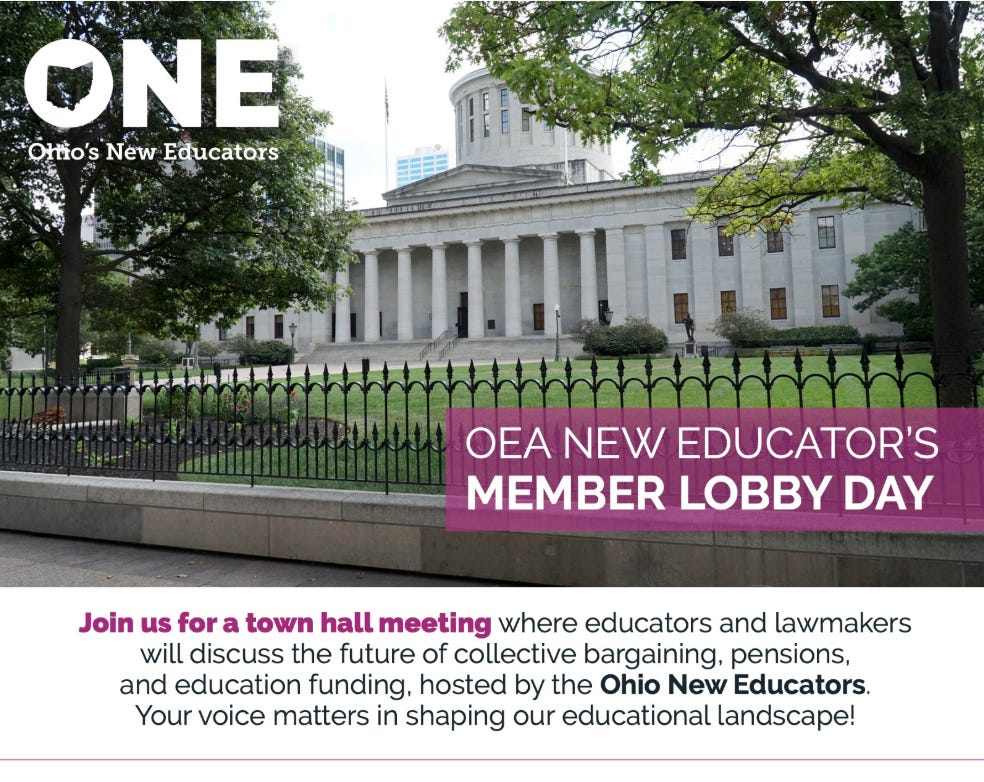
On Tuesday, October 21st, Ohio New Educators (a group of OEA members from across the state, in years 0-10 of the profession) held a town hall meeting with four legislators: Louis W. Blessing, III (R - District 8), Jason Stephens (R - District 93), Nickie Antonio (D - District 23) and Dani Isaacsohn (D - District 24). The event was advertised (as pictured above) to discuss collective bargaining, pensions, and funding.
Four questions were posed to legislators over the course of one hour. The event was moderated by a staff member of OEA, and panelists were not held to a time limited response, nor were answers given in any sort of order. It was all a bit loosey goosey around topics that are anything but.
Question 1 asked the panelists, “What does a successful graduate look like to you?”, in which Blessing (R) gave a refreshing answer that highlighted the importance of general education for all amidst programs and companies pushing for career tech starting as low as middle school.
Teen isolation, mental health struggles, and the failure to teach younger generations on how to navigate the digital world were all voiced by Isaacsohn (D), with an emphasis on the role of public education being to bring students together and have real life experiences that they (and we) learn and grow from.
Stephens (R) brought up the need to have schools provide the practical resources they used to, such as driver’s education. Access to driving is a serious barrier for the majority of rural Ohioans, and is felt within the city districts too, due to Ohio’s lack of public transportation.
Antonio (D) said kids should know their options, have experiential learning, and while she pushed back on the recent child labor expansion, she said all graduates should have a mandatory one year of service after high school graduation.
Question 2 dealt with school funding and asked legislators how to balance it with property taxes. While Blessing said the Fair School Funding Program is property tax relief in itself, he also voiced a need for a Constitutional Amendment that would allow local school boards to raise property taxes/pass levies without the issue going to the ballot box. He stated that the “aspect of democracy” remains in the fact that school board members are elected, so constituents can use the avenue of electing school board members if they are unhappy with not having a say in the amount of taxes they pay.
CORE would like to take a moment and remind readers that in June, the Ohio legislature reduced the mostly-elected-19-member State Board of Education to 5 appointed members. The Ohio legislature does not value elected school boards, what makes us think they will protect that democracy at the local level?
Stephens called for simplicity to local funding, and made the call to get rid of term limits so there is “more expertise” on “how we govern”. (Yes, you read that correctly. And no, the moderator did not ask any clarifying questions nor was it challenged by anyone on the panel.)
Antonio said the state needed to pay more and, regarding the further gerrymandering of Ohio’s legislative maps, “we’re going to have to figure it out. If not now, then down the road.” Isaacsohn called for a Constitutional Amendment for the state to pay for 50% of public school funding.
Question 3 was, “What recommendations do you have to improve teacher retention and recruitment?” Blessing acknowledged that while some love the “but they get summers off” talking point to explain abysmal salaries, it’s clearly countered by the severe teacher shortage, and called to “sweeten the pot” for teachers.
Stephens said we need to make it easier for people to be teachers, and there are several barriers to entry, such as getting an education. While it sounded like what he could have meant was the wildly climbing costs to licensing, that’s not what he said. Antonio looked into the audience and said, “We need you, we need teachers to run for office”. (Note to self: find time to run for office between differentiation, PBIS, public school works, dyslexia testing, RIMPS, and buying classroom supplies.) Isaacsohn swooped in with a voice of a reason and said they were making it too hard: pay teachers more, give them better benefits, and improve their working conditions.
The moderator posed a follow-up question only to Antonio, who had earlier highlighted that she was a special education teacher: What can we do for special education recruitment and retention? Antonio voiced that we are all better people because of special education, and bringing people of different abilities together is important for society. While this is unequivocally true, Antonio gave no actions steps to this answer. Antonio taught special education in the 1980s, with her last teaching license expiring in 1992.
Question 4 was not one from the list of submitted questions by union members for the town hall, but rather a question the moderator said he wanted to ask. The last question posed was, “Can you tell us about an educator that impacted you?”. While it could have been an acceptable icebreaker or introduction question, it instead mimicked a tactic that’s helped keep an entire profession exploited: Remember your why.
The turnout for the town hall was quite small, with no more than 30 people total, several of whom were union staff and not educators. Most educators present were already in Columbus for OEA’s lobby day; very few were able to make it to the union’s headquarters in downtown Columbus by 5pm on a workday.
The reception that followed brought more union staff and even fewer educators. With the panel not even addressing the concerns of collective bargaining or our pensions (which was how it was advertised), the moderator not sticking to questions posed by educators, and the vast inaccessibility of the town hall, it leaves one wondering: Who was this event for?
The Power of Direct Action in Our Schools
Too often, Rank & File members think of their union as the elected officials. Organizing direct action in your workplace empowers every worker and build solidarity.
How do unionized workers go about effecting change? One common way is through the service model, which has become the predominant mode of union operations. For many, this is the only way they’ve ever understood union work.
The service model relies on a few (usually elected) members of a local taking problems to management on behalf of the group. These leaders use the strength of membership numbers to legitimize their position and negotiate solutions. When issues become too big, too complex, or too legal, the state affiliate often steps in to take a seat at the table. Larger state affiliates like OEA, OFT, and OAPSE also operate within this model. They also use the service model through lobbying efforts at the state and federal levels.
The service model can be effective, but only when both sides are committed to reaching a common goal. Problems arise when management stops listening and members have grown accustomed to relying on leadership to speak for them. When the collective voice of educators isn’t being used, cracks in this model begin to show, and the rank-and-file feels the pain.
That’s where direct action comes in.
Direct action is what it sounds like: when an entire building or unit says, “This issue matters, and we’re going to do something about it.” It is more powerful than passing a concern to someone else who wasn’t there and can only speak on our behalf. Direct action comes from the people who are directly affected, using their own voices and standing together as one.
One building in Central Ohio recently showed the strength of this approach when staff members felt mistreated by a district administrator. Instead of waiting for someone else to intervene, they took matters into their own hands and drafted an open letter. Over 80% of members in the building signed it, and they sent it directly to district leadership. Within one week the administration responded, and the superintendent was held accountable.
At a Central Ohio high school, an enrollment increase led to vastly inequitable class sizes when compared to other schools in the same district. Members drafted emails and scheduled them to be delivered to their school board all at the same time. Their unified message could not be ignored, and the staff was allocated several more teachers.
In several Central Ohio districts, union members have utilized the classic march on the boss: showing up to a board meeting in union shirts. Whether it’s Columbus, Westerville, South-Western, or Delaware City, this tried and true tactic always shows power and solidarity in the room, and has been especially popular in the last year.
Direct action is about more than solving one issue. It is about standing together, making our voices impossible to dismiss, and showing that we understand the power we hold as a group. This is why collective bargaining matters so deeply: our right to speak and act together is protected. When we exercise that right, we make our schools better places for educators and students alike.
When an issue comes up in your building, ask yourself and your colleagues: Is this important enough to take action on? Is the issue deeply and widely felt? If the answers are yes, stand together, act together, and make your voices heard. If you need help organizing a direct action, or want to talk an idea through, reach out to info@core4ed.org.
Workers Over Billionaires: Labor Day Recap
CORE joined several allies to take the streets for Labor Day, and two CORE members took the mic to fight for public education.
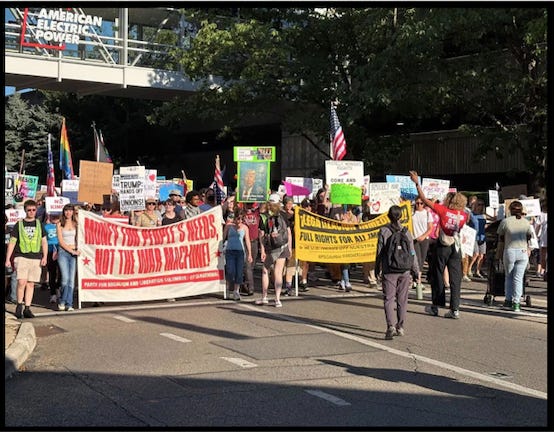
It’s a long road to May Day 2028, the day labor leaders such as Chicago Teachers Union and the United Auto Workers have pinned for a nationwide strike. We must be patient, methodical, and persistent to get there, building solidarity across industries one day at a time.
To that end, CORE joined several allies, such as the Party for Socialism and Liberation, the Starbucks Workers United, the Columbus Education Justice Coalition, Pint Size Protestors, 50501, and the Ohio State University Nurses Union, to protest the current state of affairs with a unifying demand: Workers over Billionaires. As much as the left tends to get bogged down by debates on theory and the ideal qualities of a just society, this succinct message, hailed around the country in other cities’ Labor Day protests, cuts through the noise and provides a means of consolidating our efforts.
Similarly, leftists of every stripe can unify behind the importance of education for revolutionary ends—uneducated and uncritical workers can be manipulated into believing the billionaire class is their friend. As such, CORE had the opportunity for two of our members to speak to a huge crowd at the Labor Day protest.
Their speeches cut to the heart of our dilemma as one member put it, “We are teachers, but we are also human. We are burdened with ever-increasing class sizes, a lack of essential resources, and salaries that simply don’t keep up with the cost of living. We are told to do more with less, to innovate and inspire while being stretched to our breaking point. All while billionaires like the Haslams and Wexners have more money in their pockets than they know what to do with.” The disparity between “haves” and “have-nots” only continues to widen, and public educators witness it firsthand.
The crises we face in public education are manufactured: Ohio funds its schools on the back of the working class’s property taxes, thus pitting workers against each other. Workers, including educators, who struggle to feed their own families will not support tax levies to improve their schools’ conditions, thus creating resentment between educators and their communities—and between educators themselves. Plenty of resources exist to properly fund our schools, but billionaires hoard the wealth created by Ohio’s workers and use it to lobby lawmakers, keeping their own taxes low while our struggle only grows.
These remarks did not come without a glimmer of hope. CORE’s second speaker highlighted the beauty of the crowd’s diversity, comprising an intersection of race, gender, age, sexuality, ability, and creed, all fighting for each other. That’s the America of our dreams. As we see increased attacks on educators and other professionals for exercising their free expression, however, this dream will need to become a reality sooner rather than later. Otherwise, billionaires will continue to implement their vision: an America in which their prosperity is the only thing that matters. Only through solidarity can we break the stranglehold and achieve liberation for all.
Legislative Battles: 5 Harmful Education Bills in Ohio

On the 2nd Thursday of every month, CORE joins our partners at Honesty for Ohio Education for legislative updates and action items. Below are the bills coming at us that were discussed during October’s meeting.
HB 485: “Baby Olivia Act”
What it does: Requires schools to show a misleading, anti-abortion “fetal development” video every year starting in 3rd grade
Status: 2nd hearing to be held on October 28, 2025
Details: Sponsored by Melanie Miller who admitted there is not a parental opt-out option written into the bill, but was willing to add an amendment “if people want it in writing.” The “Baby Olivia” video is AI animation.
Action: Tell the committee to reject HB485
HB 486: “Charlie Kirk American Heritage Act”
What it does: States that when providing instruction on the topic of American history, educators in public schools (including higher education) may provide instruction on the positive impacts of religion on American history. It also declares the following to be true:
“The teaching of the historical, positive impact of religion on American history is consistent with the First Amendment to the US Constitution.”
“An accurate and historical account of the influence of Christianity on the freedom and liberties ingrained in our culture is imperative to reducing ignorance of American history, hate, and violence within our society.”
“Accurate historical instruction regarding verifiable, historical impacts of religion on American history is factual and is not proselytization or a violation of the First Amendment.”
Status: 1st hearing was held on October 7, 2025
HB57: Saving Lives with NARCAN and … LifeWise?
What it does: Ensures that schools have a policy for maintaining life-saving overdose reversal drugs in emergency situations. Realizing this would be a rare W for education, the legislature added more release time for religious instruction (RTRI), and many Democrats still voted for it.
Status: Unfortunately this bill is on its way to DeWine’s desk where it will undoubtedly be signed.
SB 172: Immigration
What it does: Requires state and local public offices/officials to allow the arrest or detention of anyone who is, or is suspected of being, unlawfully present in the US and allows those to happen anywhere in Ohio under any circumstances. This applies to arrests or detentions conducted by a federal, state, or local law enforcement agency or officer, with or without a warrant, and regardless of whether the proceedings are administrative, civil, or criminal in nature.
Action: Find your rep and tell them to vote no, and print some red cards.
HB 455: 568 pages of updated Ohio’s “Parents’ Bill of Rights”
What it does:
Still requires an alert to parents if their student wishes to identify differently than their sex assigned at birth. However, it adds an exception to not report changes if there is reasonable belief that telling a students’ parents would harm the child.
In those cases, educators must report changes to law enforcement or child protective services, which is a severe concern, especially for Black and brown LGBTQ+ youth.
Removes “other mental health” changes from required reporting.
Only requires parents to be informed of mental health updates if their student exhibits suicidal ideation, or persisting symptoms of depression or “severe anxiety.”
Clarifies rules governing “sexuality content” and adds visual instruction to the definition.
Currently, parents have the opportunity to review any instructional materials that involve sexuality content and can refuse to allow their student to participate. House Bill 455 would have parents review the content of the lessons, not the specific instructional materials.
Public districts would no longer have to annually report their compliance with various state mandates.
Charter school sponsors would no longer have to report their annual expenditures to the state.
Eliminates the requirement for DEW to employ a full-time physical education coordinator.
Removes the Tutor Ohio Kids Program, a remedial program that offered tutoring to students in participating charter and public schools.
No longer requires online schools to unenroll and report students to the state if they miss state assessments two years in a row.
It’s hard to hold hope in times like these, and with advocacy clearly falling on deaf ears, we are planning the next moves. Across the state educators are getting ready to fight, because we know one thing to be true: when we fight, we win.
Learn How To Participate in Your Union
Feeling like your union is a club only for certain members? Wanting to ask questions at a meeting, but aren’t sure how? Wishing your union would take action on something, but don’t know how to present it? Come learn with CORE!
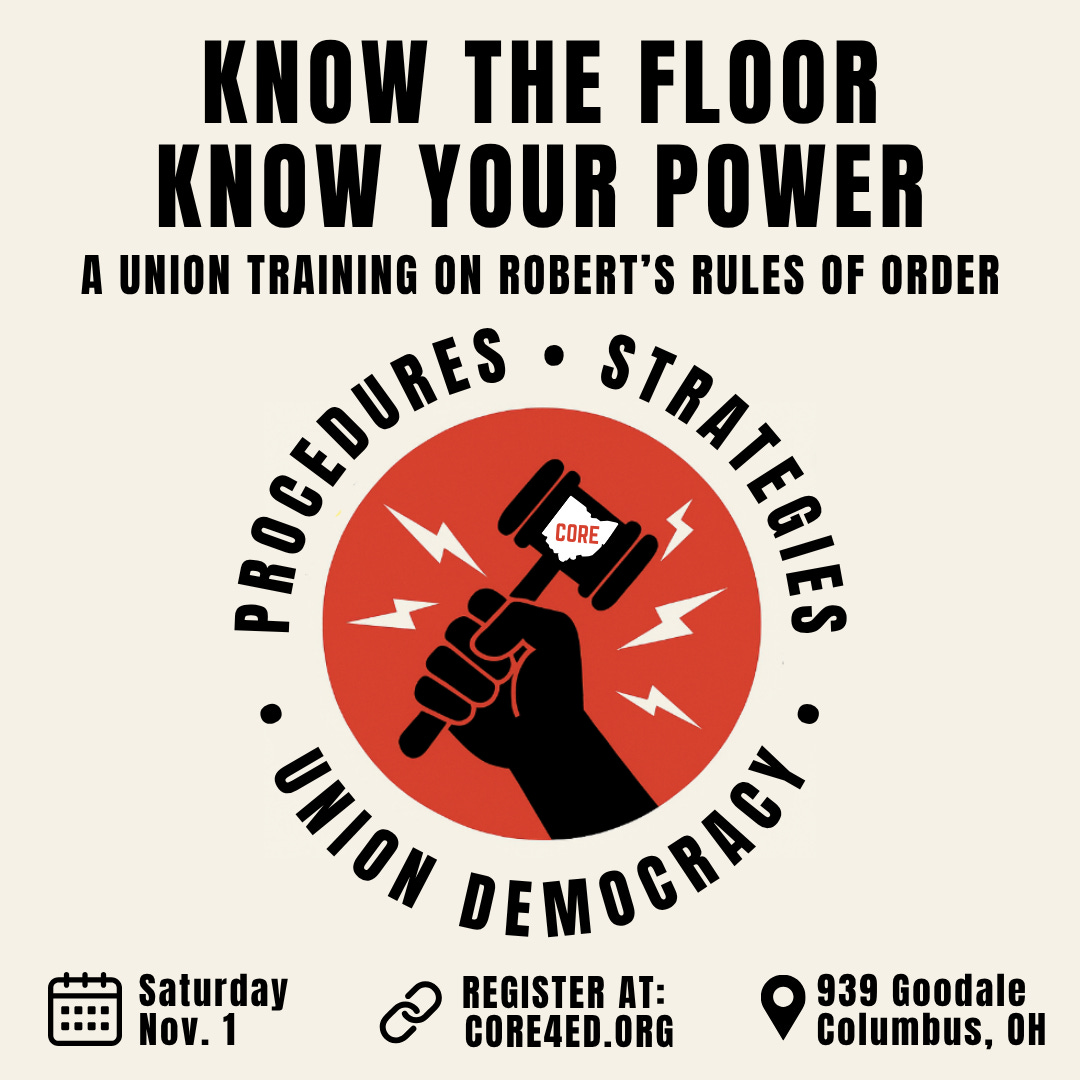
Join rank and file union members from different labor sectors to learn the ins and outs of Robert’s Rules of Order. This training will cover things such as how to make a motion, pose questions, keep democracy alive on the floor, and help get important New Business Items and Resolutions passed. In true educator fashion, this training will be interactive and participatory, which means not boring and actually useful.
In solidarity,
Central Ohio Rank and File Educators