
Educators in Ohio Fight Like Hell to Tax the Rich
How rank and file educators are pushing their union to solve the funding crisis, bring justice to public services, and be the democratic institution the union card promises.

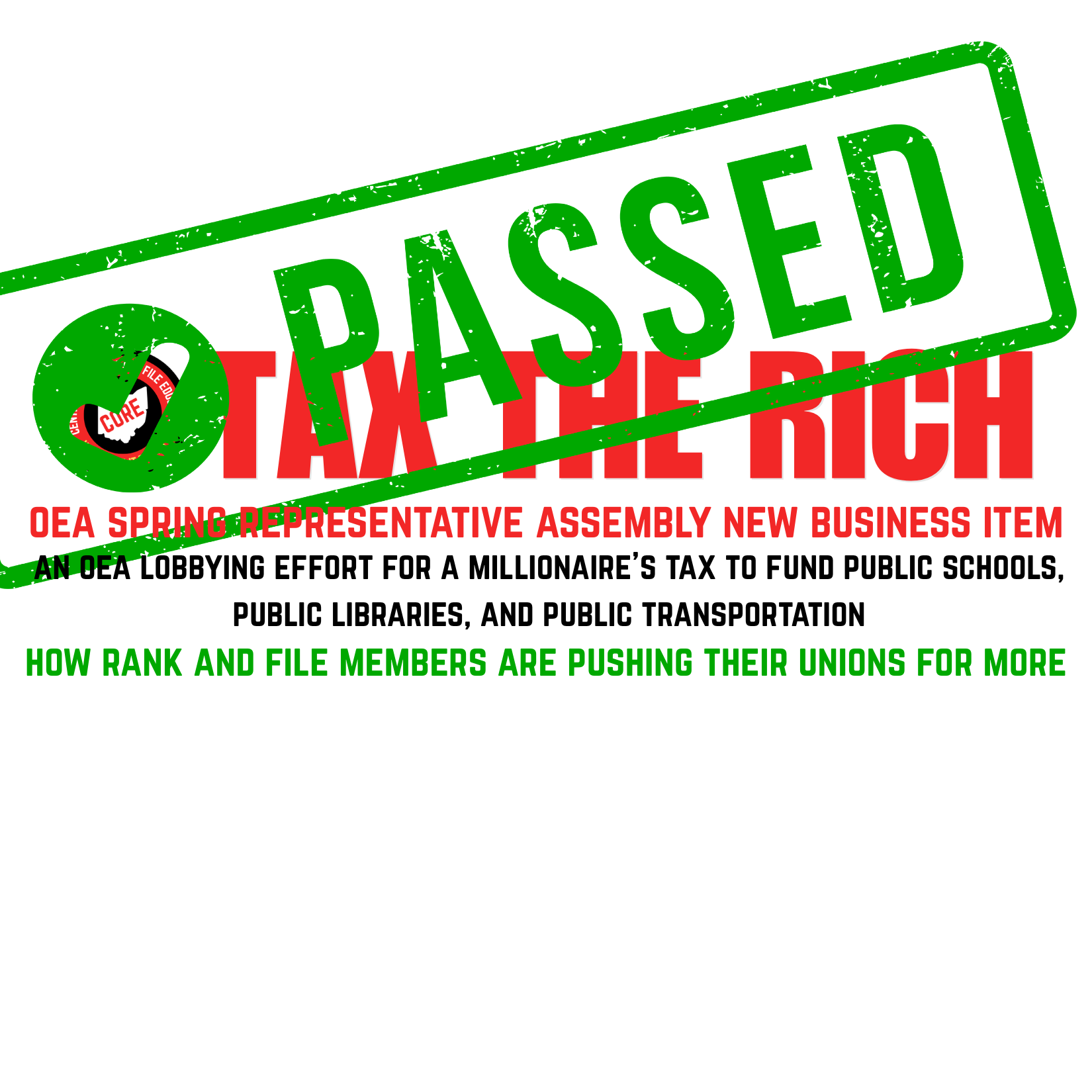
Public schools funding in Ohio is and has been an unconstitutional problem for years, relying on property taxes and widening the opportunity and resource gap between the haves and have nots. The Fair School Funding Plan was supposed to fix this; however it has never been fully implemented.
This past summer, Ohio’s republican-led legislature manipulated the formula and forced local school districts to debate huge budget cuts. With the Fair School Funding Plan left to the wayside, CORE figured it was time to take the lead from other states and reintroduce the idea of millionaires paying their fair share. In brief: tax the rich.
CORE organizers used their caucus connections to meet with the President of the Massachusetts Teachers Association and discuss in detail how they were able to generate billions of dollars dedicated towards public education, transportation and libraries. A powerful coalition led by solidarity would need to be built across public service sectors to make it happen.
First, however, we would have to get our own union on board.
CORE met with OEA President Jeff Wensing in February to bring up the idea of a millionaire’s tax to fund our schools. After already establishing direct connections with reformers in Massachusetts, we were able to come to our President with most of the work done to get the conversation started.
President Wensing was favorable to the idea and interested to learn more. Consistent outreach to him over the next few months resulted in him hearing from other states that have passed similar taxes (Illinois, Washington, Massachusetts, etc.) and thinking critically and optimistically about what it could mean for Ohio.
While he pondered, CORE submitted a New Business Item (NBI) for OEA’s spring Representative Assembly to put the question directly to the union’s best decision-making body: its members.
What steps we took to prep
The drafting of NBI language was done collectively in our statewide caucus, as well as decisions of who would be maker and second for the NBI. Several virtual meetings were held to run through speeches and strategy.
CORE reached out to OEA General Counsel weeks before the RA for assistance with the NBI and to ask about cost, but were denied the opportunity. This put an additional time crunch on the caucus—as we learned in the fall, it’d likely come with an inflated cost, and we needed to prepare for that, along with potential kill strategies.
We met several times in the weeks prior to the RA to run through oppositional talking points, floor strategy, and a quick Roberts Rules brush-up. Friday night after the RA, CORE caucused late into the night with a work session that included a food stop, gutting and rewriting of speeches, and lots of laughs.
Saturday morning before the RA started, CORE caucused over breakfast to review speeches and strategy to get the NBI over the finish line. There was a nervous energy around debate and strategy, as CORE members carried the weight of December’s kill strategies being run on the NBI, but this time we were prepared with our own plans and knowledge of how points of information can be weaponized, as we had witnessed in the Fall.
The initial cost of the NBI came in at $431,000 – nearly half a million dollars for a few OEA employees to have conversations with legislators wasn’t adding up on our end, and that would eat up most of the OEA Government Relations budget.
While we think the cause is worth it, we knew what we desired and what was being worked into the NBI wasn’t matching up.
After speaking directly with OEA Government Relations, we learned most of the cost came from a general campaign, because a millionaire’s tax would be an unpopular idea in the statehouse—but we weren’t asking OEA to run a campaign, we were simply asking them to lobby.
CORE called a caucus and debated how we should amend our language to bring the cost down and reflect our true ask. We ran through several options and weighed them all by challenging each other with different perspectives, debating potential loophole language, and leveraging all of our levels of experience.
The amended NBI came with a new price tag of $66,000. Upon running into President Wensing during the lunch break, we asked him if the OEA steering committee was preparing an amendment to kill our NBI. We were relieved when he said no, but one thing CORE has learned from the floor is to be militantly prepared for every scenario.
CORE caucused at lunch again for last minute preparations, including being ready for the amended language not being accepted, and/or an additional amendment that was proposed by others on the floor, as well as who would be at what mic and who would be willing to challenge the chair if it came to that.
Then all that was left to do was wait for the agenda to get back to New Business Items.
Finally the time came and CORE was center stage. There were 3 points of information brought up about the NBI:
Had the President has been in contact with other states that have passed something similar?
Yes, he had, thanks to CORE relentlessly pushing the topic and doing the leg work of meeting with MTA months in advance.
Why the makers decided to include public transportation and public libraries in the lobbying efforts?
Because these issues will also help alleviate property taxes, and they’re services that directly impact public education and help our students/communities.
Are delegates allowed to do this? To determine the budget and what we lobby for?
Yes, the delegates control the union, and if the delegates direct the union to do something, they must do it.
Thanks to all the preparation CORE put in, the makers were well prepared to answer these questions and our members were ready to strategize support for the NBI.
Not a single delegate audibly opposed our NBI. Our hard work and preparation led to getting an NBI passed that could actually help stop the defunding of our public schools. We saw what Representative Assemblies are supposed to be about: democracy in action.
We’ve pushed the needle to direct OEA to make progress in an area they weren’t previously doing, while still knowing we must continue to hold our elected union leaders and government accountable.