
NEA Tomorrow: Everything's Made Up and the Points Don't Matter
Our first installment of "NEA Tomorrow" gives an overview of the Representative Assembly as a whole and the most relevant updates from this year's assembly.

Surely fellow Ohioan Drew Carey wouldn’t mind us appropriating his famous catchphrase from Whose Line Is It Anyway?, especially if he could witness the similarly performative Representative Assembly (RA) of the National Education Association (NEA). Just like Whose Line, the RA features a rotating cast of lovable characters, the tension of live drama, and no real stakes whatsoever. That may be all well and good for improv comedy, but in the midst of a fascist takeover, the largest labor union in America must surely do better.
Missing context? Read the intro to this five part series on the NEA Representative Assembly:

For all of the pomp and circumstance of the RA, the grandiose speeches, and President Becky Pringle’s continued insistence that we will “Win all the things!” in public education, the RA contains very little substance for delegates to decide. In fact, we can quantify that substance: this year, the RA was told to keep spending within the $1.9 million available in the contingency fund, compared to $448,171,192 in the association’s total spending in 2025. Matters of greater importance remain under leadership’s vicegrip, even if the RA technically retains authority as the highest decision-making body in the union.
But rest assured, delegates: our union leaders are working hard to “fix” that burdensome technicality.
The most significant victory for delegates in this RA came in the rejection of Constitutional Amendment #2: “To allow NEA to decide to convene the RA every two years rather than annually.” The amendment, moved by the president of the Maryland State Educators Association and fifty other delegates, sought to “save at a minimum $14.6 million,” according to the submitted rationale. On the floor and in state caucus meetings, proponents elaborated that they have witnessed these assemblies shrink as rapidly as our general membership; we had 10,000 delegates in 1998, whereas the 2026 RA saw 5,934 delegates in attendance. With membership—and therefore member dues—declining, some cost cutting becomes necessary. Having the option to skip some years could save a great deal of money, which could be put towards unspecified organizing actions on the ground in off years.
Most of leadership stood united behind this amendment. In Ohio’s caucus debate over Constitutional Amendment 2, OEA President Jeff Wensing revealed that only one state voted against supporting the amendment in the National Council of State Education Associations (NCSEA), the gathering of state presidents and vice presidents to take positions on various proposals. While Ohio’s Steering Committee had taken no position when presenting the proposal to the caucus (mirroring the NEA Executive Committee’s stance), President Wensing spoke to the NCSEA’s support, admitting that Ohio’s leadership voted in line with leadership for political reasons more than substance. We do not have any insight into the debate among state leaders, nor the extent to which other states voted for optics over conviction. If Ohio stands as an exemplar of a broader trend, however, we face dire straits indeed.
Even taking this proposal in good faith, it does not square with the very problem it seeks to solve: if our union’s power is almost half the size it was thirty years ago as measured by RA attendance, we face a crisis of immediate urgency. It follows that the highest decision-making body in that union ought to deliberate over high-stakes actions to mobilize our entire membership and demand what we need for our profession to survive, let alone thrive.
The rank-and-file agreed, and the proposal flopped: 25.32% for and 74.68% against. However, the very submission of this proposal reveals deeper and more troubling truths about our union: leadership considers the RA superfluous and felt safe to express it openly. The various speeches this year all spoke to the strength of our members, but within the same breath, leadership asked members to limit their own power. The rank-and-file would simply need to trust that the $14.6+ million savings will go towards meaningful actions, as determined by—who else?—leadership.
If that’s what it means to “win all the things,” we would not be amiss to ask for a clearer definition of winning.
But what if Leadership is right?
Unfortunately, the even deeper truth cannot be avoided, and leadership would be absolutely correct to say the quiet part out loud in their defense: the RA does very little to serve members directly on the ground level.
In fact, many members would seem to agree. As discussed, proponents of Constitutional Amendment 2 pointed to declining representation at the RA, implying that our membership had dropped just as precipitously across a similar period. Membership has trended downward for several years, but zooming out, we are still in a period of relative strength:
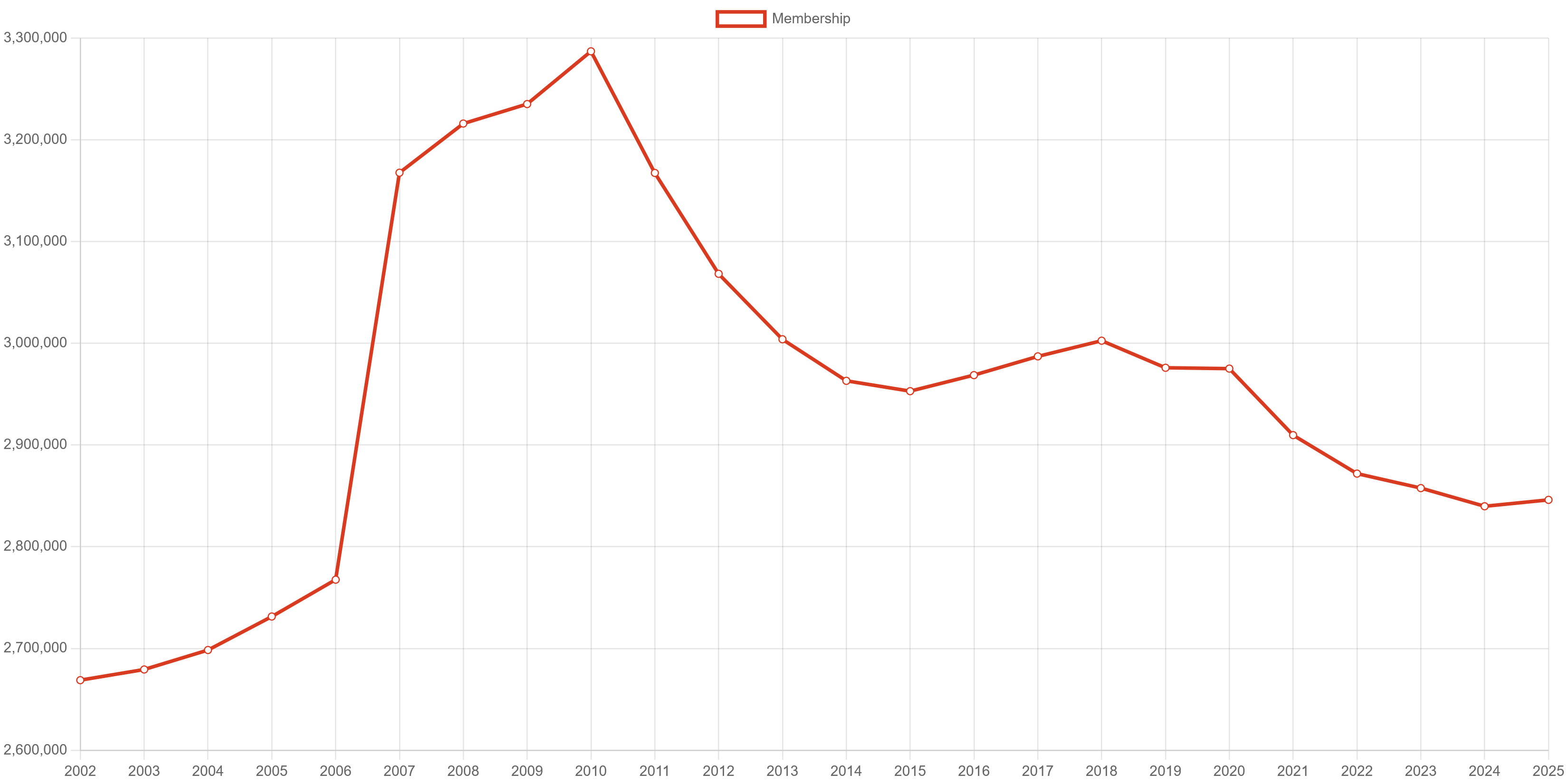
Using 1998’s 10,000 delegates as a touch-point—a notable year due to the NEA RA’s rejection of a merger with the American Federation of Teachers—, membership hovered around 2.6 million, approximately 200,000 fewer than we have in NEA today. We have more members and an RA of nearly half the size, demonstrating that locals from across the country could choose to send more delegates and do not. Rising costs for travel certainly contribute to the effect, but cost is always weighed against benefit; if the RA had a sufficient material impact on the ground—in classrooms—, locals and states would dedicate the necessary resources towards participation.
Unlike 1998, however, today’s RA lacks transformative power, as demonstrated by the New Business Items (NBI) submitted for consideration. For the uninitiated, NBIs are submitted by delegates to direct the association to take specific actions. Anyone serving as a delegate can submit one after meeting requirements to demonstrate support. Once submitted, the maker of the NBI works with NEA staffers to nail down precise language and an estimated cost of implementation.
Of the seventy-eight NBIs subject to consideration, sixty-one strictly involved gathering and distributing information, only a third of which included an element of rank-and-file organizing. Seventeen NBIs involved some form of direct action or the creation of resources for locals to take action. Forty-six proposals put implementation and impact squarely on the institution, i.e. NEA leaders and staffers, compared to thirty-two involving a member-driven component. Only twelve included any element of member-driven direct action.
It’s no surprise that many locals in NEA would consider it a waste of time and member resources to attend the RA and debate NEA publications for four grueling days.
Here’s our full breakdown the NBIs as submitted by the first day of the RA:
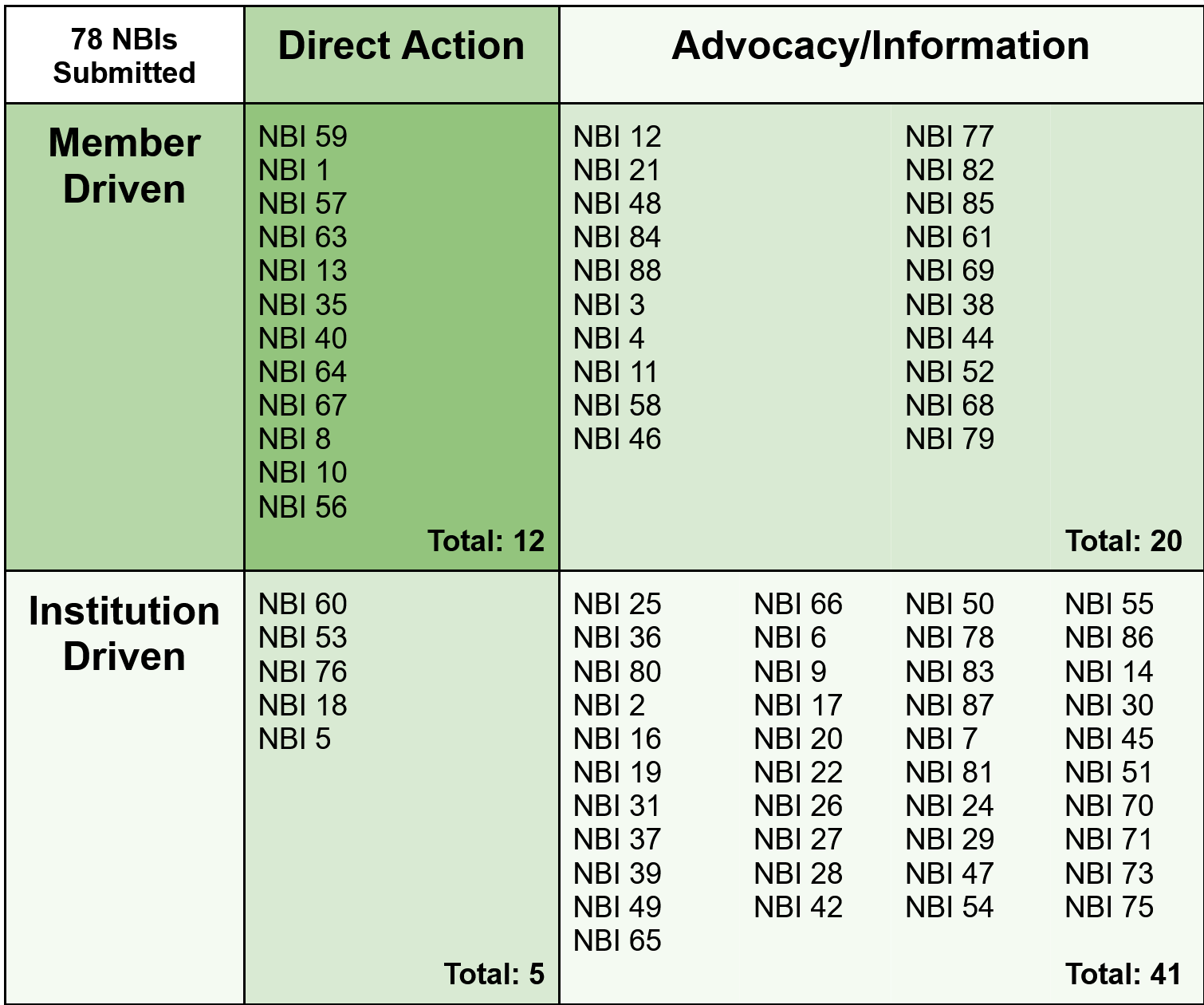
A few caveats. First, these categories do not necessarily denote the quality or efficacy of individual NBIs. NBI 1, for instance, would place QR codes in each RA allowing attendees to donate to a local Indigenous cause. With a broad definition, that qualifies as member-driven and direct action, even though the impact is relatively small. On the other side, some NBIs directing the institution to disseminate information hold great value, such as NBI 39, which asks NEA to create model school policies to protect educators and students from AI deepfakes. Still, these categories help to show the general trend: the RA’s focus is squarely on the institution’s actions and the media it produces rather than rank-and-file organizing and direct action to produce change.
Second, the intent here is not at all to shame other members for their submissions. It takes an enormous effort to get an NBI to the floor in the first place, and these proposals all come from legitimate struggles in the multi-fronted fight for educational justice.
One must inquire, however, about the theory of change driving many of these proposals. Do we really believe toolkits, articles in NEA Today, and posts on NEA’s social media will meaningfully move the needle on the fight for public education? These resources speak only to an echo chamber of other educators engaged enough to read what their national union publishes. Meanwhile, we now face federal private school vouchers, the dismantling of the Department of Education, tech oligarchs seeking to replace teachers with AI, and an executive branch waging war to manipulate prediction markets.
Nothing NEA publishes could materially impact the existential threats we face. Most educators would probably agree, especially those engaged in our union and attending the RA. So why do so many NBIs focus on information?
Most obviously, we’re in the business of educating the public; we would not be in this profession unless we believed in the power of knowledge and in the value of learning from others. And indeed, for all its flaws, the RA faithfully reproduces some of the best advances of classical liberalism: delegates can freely express themselves in debate, both sides have an opportunity to speak, and everyone can vote their conscience after thoughtful consideration and deliberation with colleagues. Our caucus may publish critical writing without (much) fear of retaliation. The debates feel lively and meaningful—until we take a step back and look at the impact.
The less obvious answer is that the structure of the RA disincentivizes risk and meaningful action. Notice the sporadic order in which NBIs were presented in the above chart—they are ordered within each bucket according to when we debated them on the floor. Rather than ordering the NBIs according to when they were submitted, the NBIs are numbered that way and then arranged into seven buckets “considered in order of alignment with NEA’s Vision, Mission, and Values,” per the RA Today blurb.
Here are the categories and corresponding NBIs, showing the (mostly) chronological order in which they were brought to the floor:
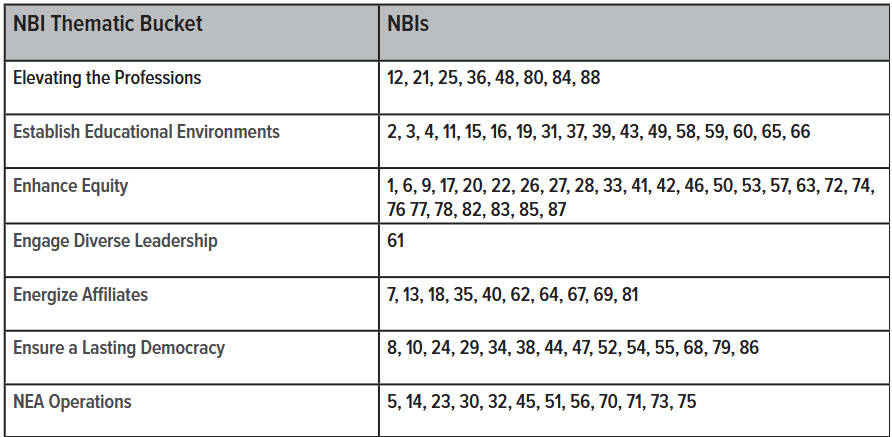
At first glance, it would be difficult to understand how something like NBI 52, which would create quarterly articles highlighting how educators are fighting for academic freedom, aligns with “Ensure a Lasting Democracy” rather than “Elevating the Professions.” There is significant overlap between categories, allowing leadership to pick and choose when the RA considers a particular item—on Day 1, with an energized delegation, or Day 4, when exhaustion takes command and the budget is nearly depleted.
As such, potentially meaningful actions like NBI 8 (fund and expand a program training educators to run for political office) and NBI 10 (march on Washington with other unions to demand impeachment and removal of Trump) not only fail to pass, but they fail to spark the exact kinds of debates we need to have for meaningful change. Even if those proposals have serious flaws or would not make an impact themselves, they at least push in the direction of challenging a power structure that has obviously failed us in public education. To debate them would help us to arrive at real answers.
Instead, NBI 8 passed after being modified into impotency, and worse, NBI 10 was removed from consideration entirely before debate, along with three other NBIs, under the argument that it was “purely political” and had nothing to do with education. An objection to consideration is incredibly rare, and it requires a two-thirds vote of the delegation to pass; seeing four objections pass on one day is almost unheard of. The exhaustion of Day 4 hits hard, and many delegates would likely have voted to adjourn early and dismiss all remaining NBIs given the chance. At least, we would prefer to believe that than the alternative, that the “purely political” argument proved compelling.
Here are summaries of the four NBIs in question:
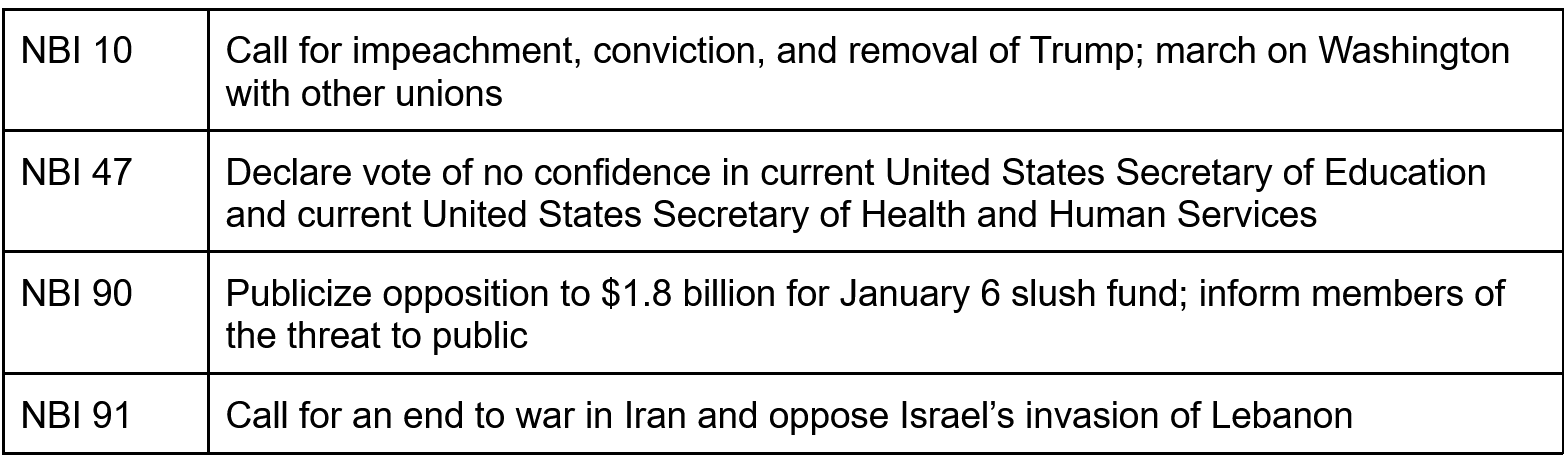
While these do not appear to impact education on the surface, all things are connected in politics; the blatant and unprecedented corruption being addressed in these NBIs causes incalculable damage to our public institutions, public trust, and democracy itself. It should go without saying that these are disastrous outcomes for public education.
In case it does need to be said: education is, always has been, and always will be political. We only harm ourselves by regurgitating the popular insistence that we ought to stay in our classrooms and get out of politics.
Regardless, the point stands that an NBI’s order in the program has a huge impact on its likelihood of success or serious debate. See below for a color-coded version of NEA’s chart, with adopted NBIs in green, defeated (or objected to consideration) in red, referred to committee (effectively killed, if not always) in yellow, and withdrawn by the maker crossed out.
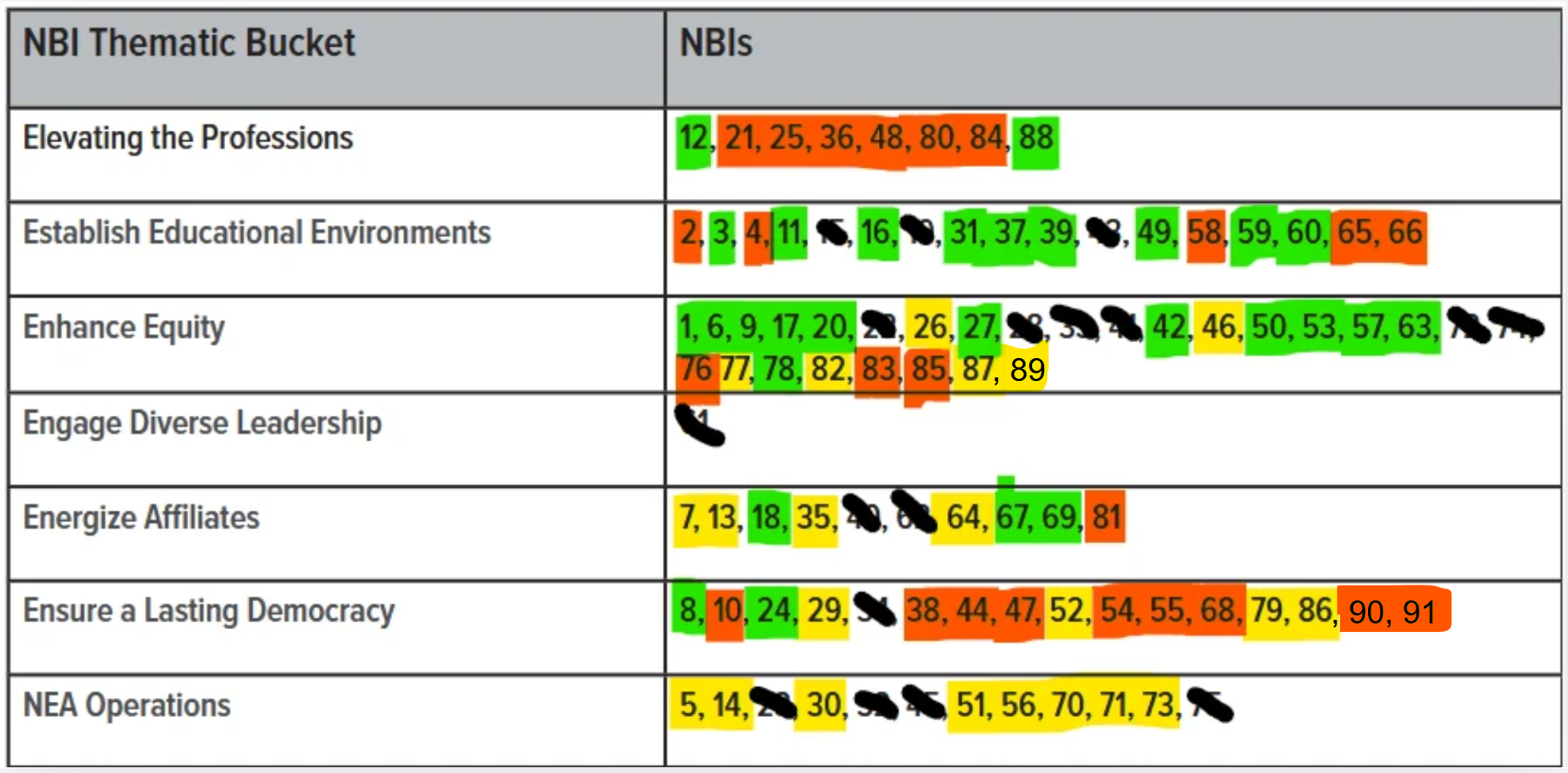
Towards the end of the RA, makers have little hope for passing their NBI, especially if it takes radical action; costs have piled up, and restlessness can be felt on the floor. Delegates even start cheering at motions to close debate. As such, many will voluntarily refer their NBI to the appropriate committee in hopes that it won’t simply die. If leadership finds the NBI at all disagreeable, however, that’s exactly what will happen.
To bring this back to the original point that the RA does very little to support members on the ground, here’s one last chart organizing the NBIs according to the same four quadrant tool shown earlier:
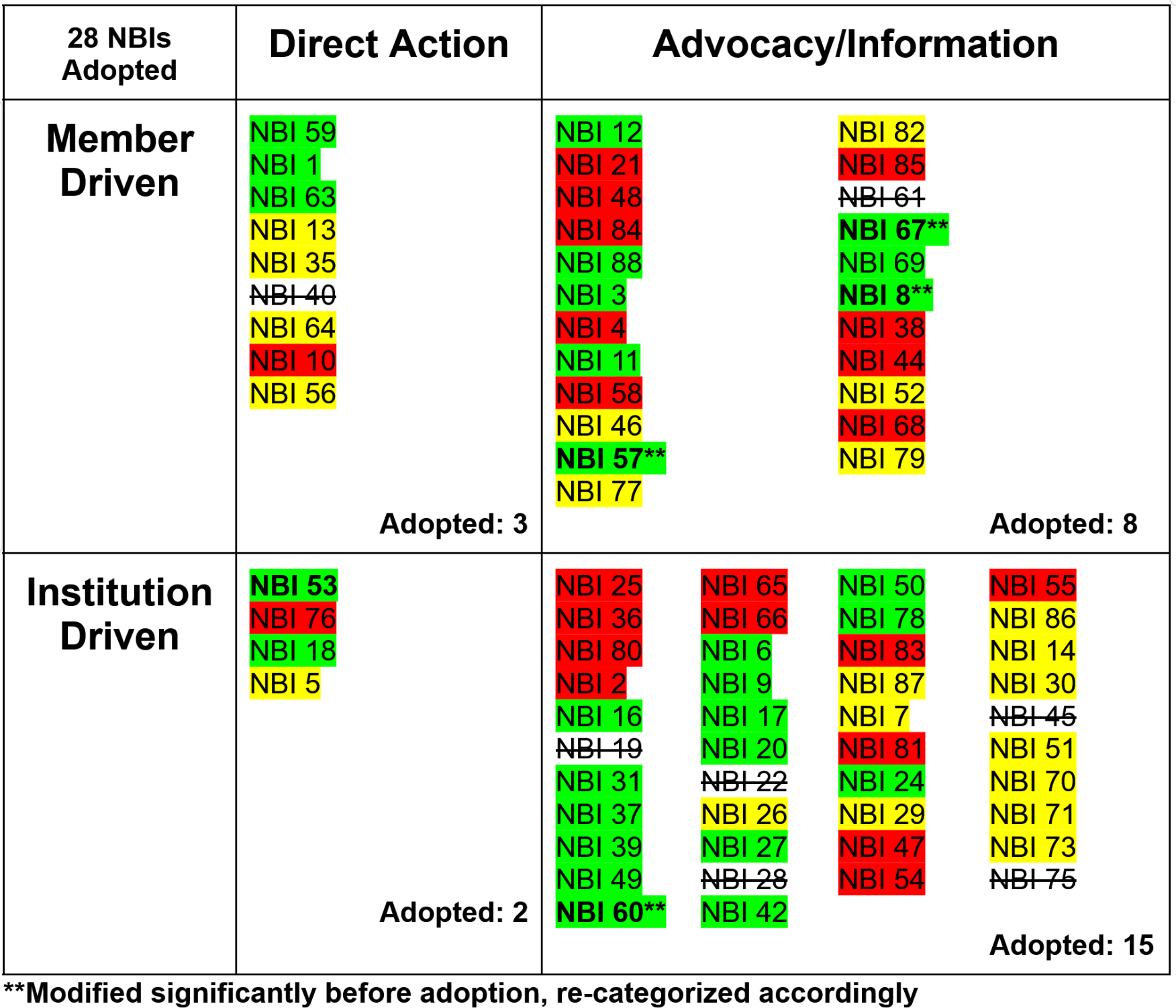
Notice that four NBIs were modified so significantly that they no longer included a component of direct action. NBI 57 would have pushed NEA to directly support local affiliates in advocating for Indigenous students; now, it will be an online repository. Instead of funding the education necessary for educators to run for office, NBI 8 will now “explore” the expansion of the NEA See Educators Run program.
As for the adopted NBIs falling under member-driven direct action, NBI 1 was already covered as one that technically qualifies but has limited impact. NBI 59 could be more significant, as it will help locals to develop “voluntary, student-led mental health support chapters,” drawing on the work of groups like the National Alliance on Mental Illness. The student-led element comes with challenges, of course, but it aligns with NEA’s Community Schools model in ways that could be beautiful. At a modest $77,000, the main action here is still to “develop and disseminate resources,” but insofar as those resources are intended to empower members to take action in their school or district, the NBI has the potential to create meaningful change.
And finally, perhaps the most interesting NBI saga of the whole RA, NBI 63. At $199,000, this was the most expensive NBI to be adopted this year, and for good reason: the NBI “will establish an emergency assistance fund for DACA educators and other members impacted by immigration enforcement actions.” The fund will be seeded with $100,000 from NEA, and the association will explore opportunities to grow it from there. This NBI is the only adopted measure that directs material resources back to the educators composing our union, and it does so in direct response to the growing threat of ICE.
This NBI also demonstrates why Robert’s Rules training is a categorical imperative for those invested in this work. In fact, the NBI failed at first; after a lengthy debate, it fell by just a few votes—50.3% against. The prevailing side argued that this action could run into illegal activity for providing substantial monetary assistance to undocumented individuals. President Pringle chimed in from the chair, seemingly to back up that point by stating, “We can only do what’s legally permissible.” However, the NBI specified “DACA educators and other members,” all of whom necessarily have documentation; furthermore, NEA has the flexibility to implement this NBI with more strict requirements if needed to avoid running afoul of the law.
Fortunately, a member of the prevailing side saw that point after discussing it further. She moved to reconsider the motion, an uncommon move allowing the body to go back to decisions that were already made, usually in the event of new information or an obvious error. The motion has to come from the prevailing side, and the mover and her second confirmed they had initially voted against and then changed their position after discussion. The body agreed to reopen and narrowly passed the NBI, again with just over 50% on the prevailing side.
After all was said and done, delegates went home with very few reasons to celebrate. For some, an uncomfortable reality settles in: the highest decision-making body in the biggest union in America expended all of that energy for a $1.9 million contingency fund compared to NEA’s approximately $450 million in total spending. Did any of this actually matter? How do we turn this around?
First and foremost, we need a broad change of culture. We need delegates unafraid to ask critical questions, challenge the status quo, and take control of the RA. Our union must start and end at the rank-and-file members working in schools across America, not the staffers, nor the elected officers, nor the politicians they serve (stick around for Parts 4 and 5 of this series for more on that). Our union has a top-down model; it follows that the behaviors of our national union filter down to the local level to varying degrees. Local organizing will awaken the organic leaders who ought to be attending the RA and pushing it for more. With a critical mass of power, the rank-and-file has plenty of tools to take back control of the RA.
One of the most intriguing ideas is to organize a movement to approve more spending than is available in the contingency fund. That fund is treated as a hard limit by leadership, yet the RA ultimately controls the entire budget of NEA. If the RA decides to spend more than the contingency fund, the books have to be opened up to cut funding elsewhere, and the RA must approve a balanced budget before adjourning. Such a move would immediately cut through all of the rhetoric about fiscal responsibility—the entire operating budget of the NEA eclipses the contingency fund, and requiring the delegation to take a hard look at the whole budget would lead to more critical conversations about NEA’s spending, the authority of the RA, and the activities we want to see from our national union in general.
To be clear, overspending is not a prerequisite for these conversations; the constitution of NEA gives the RA the responsibility to “Exercise final authority in all matters of the Association.” Rather, the point is that we must truly exercise that authority for it to be meaningful, and unbalancing the budget is one of the most available means of snapping the assembly back to attention. We would force leadership to abandon the spectacle of 30 minute speeches, fluffy videos, and Union 101 “days of learning” workshops. We would put the focus back on the struggles finding a home in our classrooms and what we need from our union to make public education thrive.
Speaking of the budget, NBI pricing reveals yet another layer in which “everything is made up and the points don’t matter.” Subscribe to the Member Action Tea for our next edition of NEA Tomorrow, and help us to build the union we deserve.